

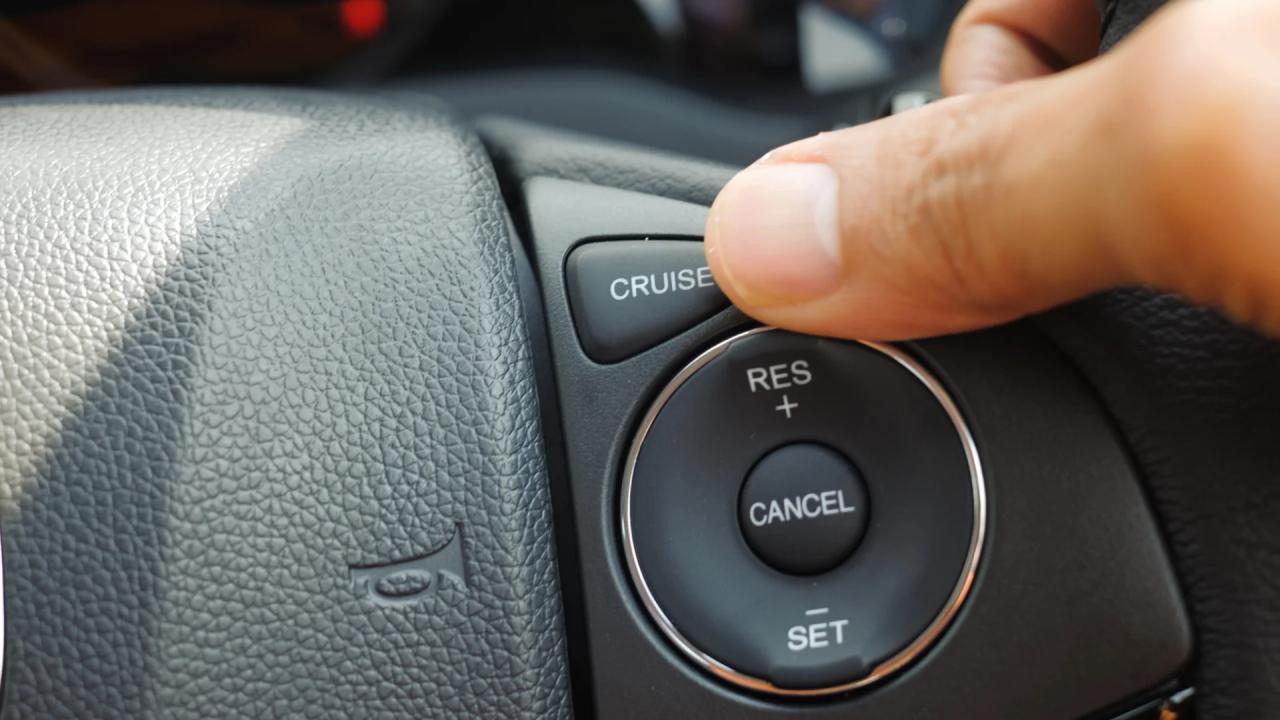
Cruise control saves fuel on a flat, clear motorway. On a hilly A-road, in moving traffic, or into a headwind, the same system can quietly use more fuel than driving manually.
The difference lies in what cruise control is actually doing to maintain your set speed. Once you understand that, it becomes straightforward to know when to use it and when to switch it off.
Key takeaways
- On flat motorway sections with light traffic, cruise control consistently improves fuel economy by smoothing out the small speed fluctuations most drivers produce unconsciously.
- On hilly terrain, conventional cruise control accelerates to maintain set speed on climbs, often more aggressively than a driver would. This burns more fuel than the steady-speed benefit recovers.
- Headwinds have the same effect as hills: cruise control holds the throttle open to maintain speed rather than easing off as a driver naturally might.
- Adaptive cruise control (ACC) and conventional cruise control behave differently, particularly in traffic. They should not be treated as the same tool.
- The fuel economy case is strongest on flat, open motorway sections at a consistent speed. On any other road type, the answer becomes conditional.
Why cruise control helps on the flat — the mechanism
Most drivers unconsciously vary their speed by a few mph while maintaining what feels like a constant pace. This fluctuation means small repeated cycles of acceleration and deceleration, each acceleration event burns more fuel than maintaining the same average speed steadily would. Cruise control eliminates this micro-variation. Compare how your car’s fuel efficiency stacks up to see how much room there is for improvement.
On flat terrain at a consistent speed, with no traffic requiring speed changes, the result is a marginally but consistently lower fuel consumption than typical manual driving over the same distance. The benefit is real. It is also modest, this is not the largest fuel-saving lever available to a driver. Smooth driving technique achieves much of the same result without any button pressed.
A note on transmission type: most real-world cruise control use is on automatic cars, where the system manages both throttle and gear selection. On manual cars, the driver still manages gears, and many manual drivers do not use cruise control at all. The fuel economy effect can vary between transmission types, a modern dual-clutch or CVT may respond differently from an older torque converter automatic, but the core principle is the same: steady speed on flat terrain uses less fuel than fluctuating speed.
Where the benefit reverses — hills
When the road rises, speed begins to fall. Conventional cruise control responds by opening the throttle to recover the set speed. The system does not know the gradient is temporary. It responds to the speed drop and applies power.
A driver looking at the road ahead would see the hill, ease off slightly, accept a modest speed reduction on the climb, and recover naturally on the descent. This uses less fuel over the hill than maintaining strict speed throughout.
Conventional cruise control cannot anticipate the road ahead; it reacts to speed changes after they happen. It reacts to the speed that has already dropped, which means the throttle response is delayed and then potentially aggressive. On a long or steep climb, this can result in a late, heavy throttle application, the opposite of the smooth driving that helps fuel economy on the flat.
On the descent, cruise control may apply engine braking or the service brake to prevent the car exceeding set speed. This wastes kinetic energy that a driver might use to carry momentum into the next section of road.
The practical implication: on rolling terrain, the kind found on most of the UK outside the motorway network, conventional cruise control often worsens fuel economy compared to attentive manual driving. Anyone who has driven the A66 across the Pennines or the A9 through the Highlands with cruise control engaged will recognise the pattern: the engine working harder on the climbs than feels necessary, the brakes trimming speed on the drops. That is fuel being spent and then wasted.
The headwind problem — same mechanism, less visible
Wind resistance increases with the square of speed. A headwind is aerodynamically equivalent to driving faster, the car experiences more drag than it would in calm air at the same ground speed. Cruise control responds to the resulting speed drop by opening the throttle, just as it does on a hill.
A driver who senses a headwind might back off slightly and accept a marginally lower speed rather than fighting it with throttle. Cruise control does not make that adjustment. On exposed UK routes, the M62 across the Pennines, the M6 through the Lake District, coastal roads in Scotland and Wales, crosswinds and headwinds are frequent. On such roads, cruise control may produce worse fuel economy than a driver who is reading the conditions.
Tailwinds produce the opposite effect, the system may reduce throttle to prevent exceeding set speed. The net effect over a journey with variable winds is difficult to predict, but the principle holds: cruise control reacts to speed changes after they happen, rather than anticipating the cause.
Traffic — where conventional and adaptive cruise control diverge
Conventional cruise control in traffic: the driver must disengage manually when the vehicle ahead slows. In anything other than free-flowing traffic, this means repeated engagement and disengagement. Frequent transitions negate the smooth-speed benefit, and the acceleration back to set speed after each disengagement is itself a fuel cost. In stop-and-go conditions, conventional cruise control provides no fuel economy benefit and adds workload.
Adaptive cruise control (ACC) in traffic: ACC adjusts speed automatically based on the gap to the vehicle ahead. It can slow and re-accelerate without driver input, making it usable in flowing motorway traffic. The fuel economy implications depend on the system’s acceleration profile. Some ACC implementations accelerate back to set speed smoothly and gradually, which is fuel-efficient. Others, particularly in older or lower-specification vehicles, accelerate more eagerly, potentially using more fuel on re-acceleration than a careful manual driver would.
The honest position: ACC’s fuel economy benefit in traffic depends on the specific system’s calibration and is not guaranteed to be better than attentive manual driving. The benefit is most reliable in flowing traffic at motorway speeds with moderate, predictable variation. In genuine stop-and-go conditions below about 30 mph, the picture is less clear.
The speed you set matters more than the system you use
Aerodynamic drag increases with the square of speed. Cruise control set at 70 mph on a flat motorway is more fuel-efficient than manually fluctuating between 68 and 76 mph over the same distance. But it is less fuel-efficient than steady manual driving at 60 mph. The comparison is between cruise-controlled and manual driving at the same speed, not between different speeds.
A driver who sets cruise control at 70 mph and believes they are doing everything they can for fuel economy is missing the larger lever: the speed itself. Setting it at 65 mph instead of 75 mph produces a meaningfully larger fuel saving than the smoothing benefit of cruise control at any single speed. Some ACC systems have a speed offset feature that lets you set a buffer below the detected speed limit, where available, this is a practical way to combine the consistency of cruise control with a slightly lower average speed.
Quick guide: when to use cruise control and when to switch it off
Use cruise control:
- Flat to gently undulating motorway sections with light, consistent traffic
- Dual carriageways with predictable flow and minimal gradient
- Long A-road sections across genuinely flat terrain, Lincolnshire, the Fens, parts of East Anglia
- Any section where the road ahead will not require a significant speed change for at least the next few minutes
Switch it off:
- Any road with noticeable gradient changes, rolling hills, moorland, significant undulations
- In any traffic that requires speed variation, even moderate motorway bunching
- In headwind or crosswind conditions on exposed routes
- In wet, icy, or low-grip conditions, maintaining set speed regardless of grip is a safety risk, not just a fuel economy question
- On winding A-roads and B-roads where the set speed would require braking into corners
- Approaching junctions, roadworks, or known traffic disruptions
The comparison that actually matters — cruise control vs smooth driving
Cruise control on the flat works because it produces smooth, consistent speed. A driver who naturally drives smoothly, looks ahead, maintains consistent speed, avoids unnecessary acceleration, achieves much of the same benefit without pressing any button.
The fuel economy gain from cruise control on a flat motorway is the gap between average manual driving and smooth, steady-speed driving. For a driver whose speed wanders significantly, the gain is larger. For a driver who already drives with good anticipation and smooth throttle management, the gain is smaller. Cruise control is most useful as a corrective for unconscious speed variation, not as a replacement for attentive driving.
And whichever technique you use on the motorway, the price you pay per litre at the other end still matters more per tank than the difference between the two approaches. Find the cheapest petrol near you before you fill up, a 6p per litre saving over a 55-litre fill is £3.30, which is likely more than any single journey’s worth of cruise control benefit.
Common myths about cruise control and fuel economy
“Cruise control always saves fuel”
It saves fuel on flat, clear roads. On hilly terrain or in traffic, it can use more fuel than attentive manual driving. The condition matters more than the feature.
“Adaptive cruise control is always more fuel-efficient than conventional”
In flowing motorway traffic with light variation, often yes. In stop-and-go traffic, the answer depends on the system’s acceleration calibration and is not guaranteed. ACC is not a universal fuel-saving upgrade over conventional cruise control in all conditions.
“Higher cruise control speeds are just as efficient as lower ones”
Aerodynamic drag increases sharply with speed. Setting cruise control at 80 mph uses significantly more fuel than at 70 mph over the same distance, regardless of how smoothly the speed is maintained. The smoothness benefit does not offset the drag penalty of higher speeds.
“Cruise control is the most important fuel-saving tool on a motorway”
Speed is a larger lever. Driving at 65 mph without cruise control uses less fuel than driving at 75 mph with it. Where you fill up, the price difference between a motorway services and a supermarket forecourt, can represent more money per tank than a journey’s worth of cruise control benefit.
Routes and landmarks
Jump straight to route planning or landmark fuel pages while you read.
Keep reading
What Is a Good Petrol Price in the UK?
A good petrol price is one that is competitive for your area and station type, not just low against a national headline average. A price that looks expensive in a competitive super...
Is Eco Mode Worth Using? What It Actually Changes and When It Helps
Eco mode does save fuel. The changes it makes are real, and in the right conditions they produce a genuine if modest improvement in economy. The catch is that what Eco mode changes...
Do Older Cars Use More Fuel? How to Tell What’s Age, What’s Neglect, and What’s Fixable
Older cars often do use more fuel. But the reason is rarely just age. The most useful distinction is between genuine mechanical wear that accumulates over time, maintenance neglect...

PetrolSavings Editorial
Editorial Team
Explore fuel savings tools
Use calculators and local price searches to plan smarter journeys.
We check for new prices every 5 minutes. Every price shows when it last changed, so check that before comparing deals.