

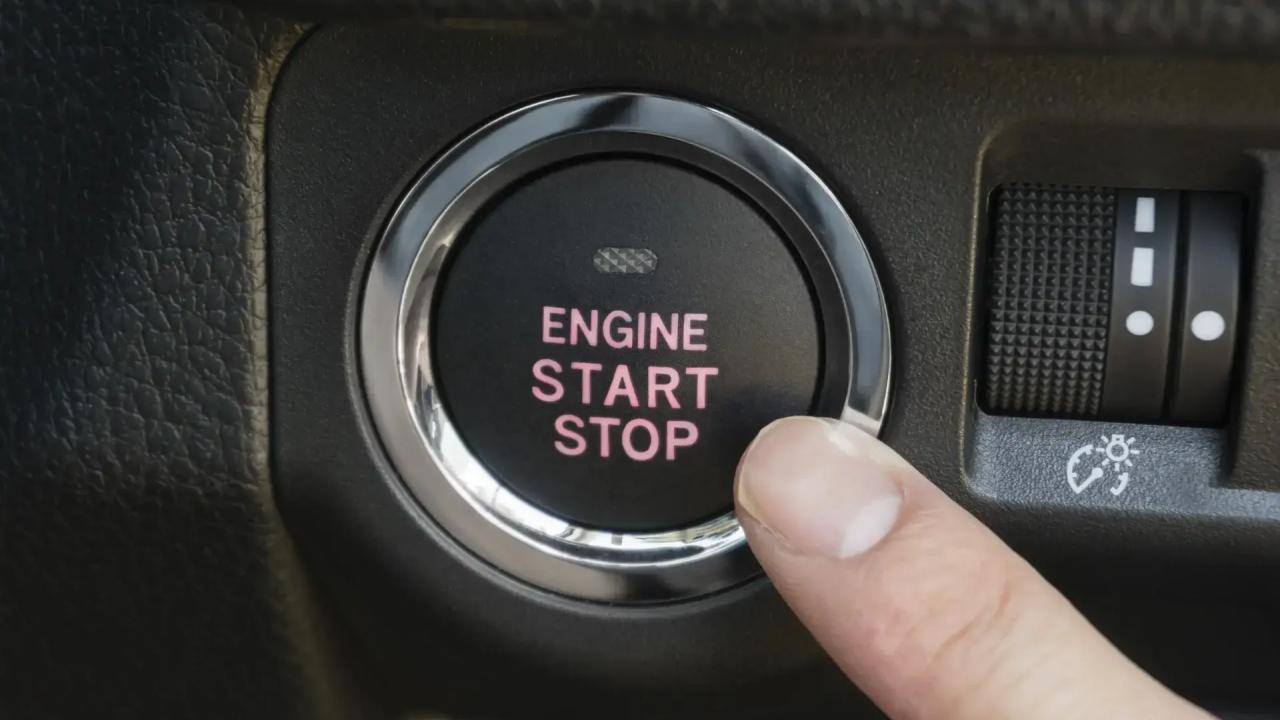
Switching off a warm engine in a stationary queue does save fuel. How much you save, and whether you should do it manually or let the car handle it, depends on what you are driving.
This article explains the honest answer for each vehicle type, including why the common instinct to disable a stop-start system is almost always wrong.
Key takeaways
- An idling engine burns fuel continuously, petrol and diesel both. Switching off eliminates that waste entirely for the duration of the stop. The saving is real.
- If your car has a factory stop-start system, it handles this more efficiently than you can manually. Leave it on. Disabling it to protect the starter motor is based on a misunderstanding of how these systems are built.
- On older cars without stop-start, manually switching off in stops clearly lasting more than roughly 30 seconds is worthwhile, but not for very short stops, and not on a cold engine.
- A cold engine running for less than two to three minutes should not be switched off repeatedly. The restart fuel cost and warm-up enrichment cycle reduce or eliminate the saving.
- Idling on a public road with the engine running may attract a fixed penalty notice under the Road Traffic (Vehicle Emissions) Regulations 2002, though enforcement is rare outside designated zones.
What idling actually costs
An idling engine burns fuel at a low but continuous rate. The combustion cycle keeps running, injectors fire, pistons move, the alternator turns, but the car goes nowhere. Every minute of idling is fuel spent on maintaining engine rotation and running accessories rather than producing forward motion. The rate varies with engine size, temperature and electrical load, particularly air conditioning. The direction is simple: idling burns fuel, and the longer the stop, the more is wasted.
The threshold question: when does switching off beat idling?
There is a crossover point beyond which switching off and restarting uses less fuel than continuing to idle. For a warm engine, that point is a matter of seconds, not minutes. The restart itself uses a small burst of fuel; idling burns fuel continuously. Beyond a short threshold, the idle loss exceeds the restart cost. For a warm petrol engine, a queue you can see will last more than roughly half a minute is long enough that switching off is the lower-consumption option. Very brief stops, a few seconds at a changing traffic light, are not worth the interruption.
A cold engine changes the calculation. In the first two to three minutes after a cold start, the engine management runs in enrichment mode, more fuel per cycle, higher idle revs, faster warm-up. Switching off and restarting during this phase resets the cold-start cycle partly or fully. If the engine has been running for under a couple of minutes, the switch-off saving is reduced. On a very short trip in cold weather, it may not exist at all. Once the engine is warm, the standard guidance applies.
Your car type changes the answer
Modern cars with factory stop-start (most new cars from roughly 2012 onwards): The system does this automatically, and it does it better than manual intervention. It uses a reinforced starter motor rated for tens of thousands of cycles, an absorbed glass mat (AGM) battery designed for repeated partial discharge, and engine management software that monitors battery state, cabin temperature, coolant temperature and steering input before deciding whether to cut the engine. Leave it on. The common instinct to disable stop-start to protect the starter is based on the behaviour of conventional starters, not these systems.
Older cars without stop-start (pre-2010 approximately): Manual switch-off is the only option, and it is worth doing in stops clearly longer than a short threshold. The conventional starter is not rated for the cycle counts a stop-start system handles, so repeated cycling in very short succession is not ideal, but occasional use in genuine queues is not damaging in any meaningful way. If the queue will last more than roughly 30 seconds and the engine is warm, switching off is the lower-consumption option.
Diesel engines: The same principles apply, with one additional note. A cold diesel switched off and restarted repeatedly before reaching operating temperature can cause incomplete combustion and deposit build-up over time. This is a long-term maintenance concern, not a per-trip fuel economy issue, but worth noting for drivers of older diesels doing many short trips in cold weather.
Full hybrids (Toyota, Lexus systems and equivalents): The engine management shuts the combustion engine off automatically at low speeds and in queues, routing power from the battery pack. Manually switching off a hybrid makes no sense, the system is already managing this more efficiently than any manual action.
Mild hybrids (48V belt-starter systems): Similar to full hybrids in this context. The integrated starter-generator handles stop-start automatically and is engineered for it. Leave the system to operate as designed.
AC, heating and the load that changes the idle cost
An idling engine running the air conditioning compressor uses noticeably more fuel than one idling with everything off. The AC compressor is belt-driven and adds a meaningful load at idle. In summer traffic with AC running, the argument for switching off is stronger, not weaker, the engine is burning more fuel to idle with the AC on than without it.
When you switch off, the AC stops too. That may be uncomfortable in stationary traffic in warm weather. That is a comfort trade-off, not a fuel economy one. On stop-start cars, the system monitors cabin temperature and may choose not to cut the engine if the AC is running hard. This is by design.
The legal position on idling in the UK
Leaving a stationary vehicle’s engine running unnecessarily on a public road is covered by the Road Traffic (Vehicle Emissions) Regulations 2002 in England and equivalent provisions in Scotland and Wales. A local authority enforcement officer can issue a fixed penalty notice.
Enforcement in practice is targeted. Most activity is outside schools, hospitals and air quality management areas rather than general traffic queues. The regulations are more relevant as background context than as a primary driver of behaviour, but drivers who idle habitually outside schools or in designated zones should be aware they exist.
Common myths about idling and stop-start
“Stop-start damages the starter motor and battery”
Not on cars engineered for it. Factory stop-start systems use a reinforced starter rated for a far higher cycle count than a conventional unit, and an AGM battery designed for the partial discharge pattern. The concern is valid for conventional starters and standard lead-acid batteries. If you manually cycle a non-stop-start car off and on in tight succession, you add wear to components not designed for it. On factory stop-start cars, the concern does not apply.
“The fuel saving from stop-start is negligible”
The saving on any individual stop is small. Cumulatively, in urban driving with frequent stops, the aggregate saving over a week of commuting is real. The RAC and manufacturers who have published data on this consistently show a measurable benefit in heavy urban traffic.
“I should switch off at every red light”
On a car with factory stop-start: the system already does this, more smoothly and with better judgement than manual operation. On older cars: switching off at every light, including 10-second waits, is more disruptive than useful and adds wear for minimal gain. In a clear queue that will obviously last, yes. At every traffic light regardless of duration, no.
“Diesels should never be switched off in traffic”
An overcorrection from concerns about diesel particulate filters and cold diesel behaviour. A warm diesel switching off in queues is fine. The DPF concern applies to very short urban trips where the engine never gets hot enough to regenerate the filter, that is a separate issue from switching off in a stationary queue.
Quick guide: when to switch off and when not to
Situation | What to do |
|---|---|
Modern car, stop-start on, engine warm | Leave system on, it manages this better than you can |
Modern car, stop-start disabled by driver | Re-enable it. The system is designed for this |
Older car, no stop-start, engine warm, clear long queue | Switch off |
Older car, engine cold (under ~3 min running) | Leave running, restart cost and warm-up cycle reduce saving |
Older car, very short stop (under ~15–20 seconds) | Not worth it for brief stops |
Full hybrid or mild hybrid | Leave system to manage automatically |
AC running hard in summer traffic | Switching off still saves fuel, but cabin heats up |
Stationary outside school or designated zone | Be aware of idling enforcement regulations |
This table reflects general guidance : the specific behaviour of your vehicle’s stop-start system may vary. Check your handbook if uncertain.
Keep reading

What Is a Good Petrol Price in the UK?
A good petrol price is one that is competitive for your area and station type, not just low against a national headline average. A price that looks expensive in a competitive super...
Is Eco Mode Worth Using? What It Actually Changes and When It Helps
Eco mode does save fuel. The changes it makes are real, and in the right conditions they produce a genuine if modest improvement in economy. The catch is that what Eco mode changes...
Do Older Cars Use More Fuel? How to Tell What’s Age, What’s Neglect, and What’s Fixable
Older cars often do use more fuel. But the reason is rarely just age. The most useful distinction is between genuine mechanical wear that accumulates over time, maintenance neglect...

PetrolSavings Editorial
Editorial Team
Explore fuel savings tools
Use calculators and local price searches to plan smarter journeys.
We check for new prices every 5 minutes. Every price shows when it last changed, so check that before comparing deals.