

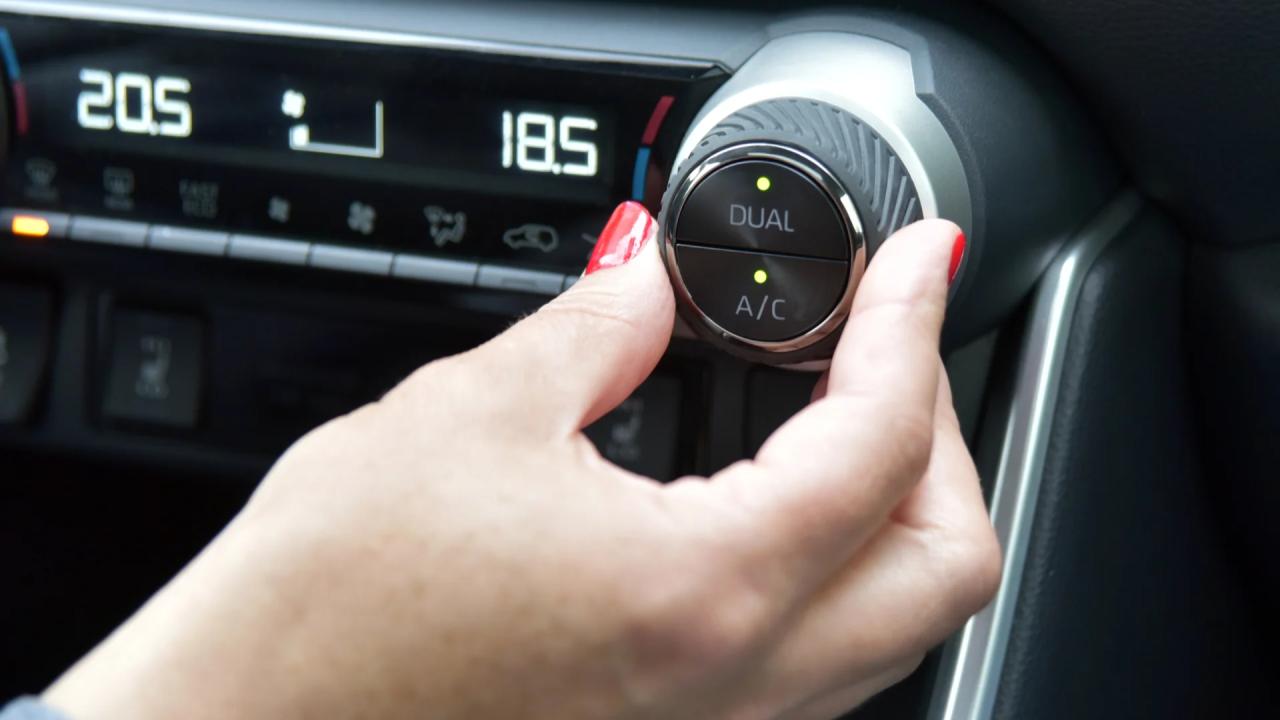
Both arguments are valid, but they apply in different situations. Air conditioning increases fuel use because the compressor places a mechanical load on the engine. Open windows can also increase fuel use by creating aerodynamic drag, and that drag rises sharply as speed increases.
Which option is more efficient depends on several factors: how fast you are driving, how hot it is outside, how hard the air conditioning system is working, and how aerodynamic your vehicle is.
This article explains both mechanisms and gives a practical answer for typical UK driving conditions.
Key takeaways
- Air conditioning places a load on the engine via the compressor, this costs fuel regardless of speed, though the load varies significantly with ambient temperature and how hard the system is working.
- Open windows create aerodynamic drag that increases sharply with speed. Above roughly 50–60mph for a typical car, this drag can cost more fuel than running the AC system.
- In UK summer conditions, moderate temperatures, mostly urban or mixed driving, the AC fuel penalty is real but often smaller than commonly quoted figures suggest, because those figures are derived from hotter-climate testing.
- Boxy vehicles like SUVs and MPVs are more sensitive to open-window drag than aerodynamically optimised cars, the crossover speed is lower for them.
- The middle-ground options, fan only, partially open rear windows, sunroof tilt, are often the most efficient choice in mild UK conditions and are frequently ignored.
Why both sides have a point
The AC compressor load: Air conditioning works by compressing refrigerant gas, a process driven by the engine via a belt-driven compressor. When the AC is running, it places a mechanical load on the engine, which must burn slightly more fuel to maintain the same speed. The size of this load depends on how hard the compressor is working: maximum cold on a 35°C day in direct sun is a significantly higher load than maintaining 21°C on a 20°C overcast day. Modern climate control systems cycle the compressor on and off to maintain the set temperature, reducing the fuel penalty compared to a system running continuously at maximum.
The aerodynamic drag from open windows: At low speeds, opening a window has minimal aerodynamic effect, the disturbed airflow does not add significantly to the total drag the engine must overcome. At higher speeds, aerodynamic drag increases with the square of velocity, and open windows create turbulent airflow that adds measurably to that drag. The effect is larger for vehicles with upright, boxy shapes, SUVs, MPVs, vans, than for low, sleek cars, because the disruption to the car’s designed aerodynamic profile is proportionally greater.
Both mechanisms are real. The question is which one dominates at a given speed, in a given car, on a given day. Find the cheapest petrol near you saves more per tank than optimising either setting, but understanding the trade-off means you are not wasting fuel on the wrong choice.
The crossover point
For a typical mid-size petrol hatchback, the most common vehicle type in the UK, the crossover point at which open-window drag begins to cost more fuel than the AC compressor is approximately in the 50–70mph range. This is a range, not a fixed figure, because several variables shift it.
What pushes the crossover lower (AC becomes preferable at a lower speed): more windows open, a boxy or upright vehicle shape, moderate ambient temperature where the AC compressor is not working particularly hard, and a modern efficient AC system with a lower fuel penalty per unit of cooling.
What pushes the crossover higher (windows down remains preferable up to a higher speed): only one window partially open, an aerodynamically sleek vehicle, very high ambient temperature with the AC compressor at maximum load, and an older or less efficient AC system.
The practical implication for UK motorway driving at 70mph: this is above the crossover for most typical family cars with multiple windows open. AC is the more fuel-efficient choice at motorway speed in most common configurations. For UK urban driving under 30mph: below the crossover for almost all vehicles. Windows down costs less in fuel at low speeds, though the margin is small.
UK summers are not hot enough to make AC the villain
Most widely circulated figures for the AC fuel penalty are derived from testing in warm or hot climates, or under worst-case conditions, maximum AC, high ambient temperature, full sun load. In southern Europe or the US South, where summer temperatures regularly exceed 30–35°C, the AC compressor runs at high load for extended periods.
UK summer temperatures are typically 18–25°C on warm days. On a typical British summer day, a car’s climate control set to 21°C may barely run the compressor much of the time, the system is maintaining a comfortable temperature, not fighting a heat differential of 15°C or more. The fuel penalty from AC in moderate UK conditions is real but considerably smaller than the commonly repeated figures. It is not zero, but it is also not the significant drain that some advice implies.
The role of vehicle shape
Aerodynamic drag from open windows is not equal across vehicle types. A streamlined saloon or modern hatchback is affected less by an open window than an SUV with an upright windscreen and boxy profile. For SUV and MPV drivers, a large and growing proportion of UK car buyers, the crossover speed is likely lower than for hatchback drivers. The disruption to airflow around an upright, boxy vehicle from open windows is proportionally larger.
Van drivers should note: vans are among the most drag-sensitive vehicles on UK roads, and the fuel penalty from open windows at motorway speeds is meaningful. If you drive a panel van on the motorway regularly, AC is almost certainly the cheaper option above 50mph.
The overlooked middle ground
Fan only (no AC): The cabin fan circulates air without running the compressor. On mild UK days under about 22°C, this provides adequate ventilation with no compressor fuel penalty and no aerodynamic drag. It is the most fuel-efficient cooling option when conditions allow it.
Partially open rear windows: Cracking the rear windows with fronts closed creates some airflow with less turbulent drag at the front of the vehicle. A partial compromise that works at moderate speeds.
Sunroof tilt: A sunroof opened to the tilt position provides airflow without the large drag profile of open side windows. At moderate speeds, this can be more efficient than either full AC or fully open side windows.
Recirculation mode: When AC is running, recirculation mode circulates cabin air rather than drawing in hot outside air. This makes the system more efficient, it is cooling air already near the target temperature. Switch to recirculation once the cabin is comfortable; it reduces the compressor load and therefore the fuel penalty.
Comfort and concentration matter too
Driver fatigue and reduced concentration are documented effects of driving in high heat. Where the fuel difference between AC and windows down is small, which it often is in UK conditions, the comfort and safety argument can reasonably take precedence. This article’s job is to help you make an informed fuel economy decision, not to override your judgment about your own comfort on a warm afternoon.
Comparison at a glance
Based on typical UK driving conditions and a mid-size petrol hatchback. Results vary by vehicle shape, number of windows open, ambient temperature, and AC system. No universal winner.
Condition | Windows down | AC (sensible setting) | Fan only (no AC) |
|---|---|---|---|
Urban under 30mph, mild day (<20°C) | Low drag, minimal fuel penalty | Small compressor load | Best option if comfortable |
Urban under 30mph, warm day (22–28°C) | Low drag, minimal fuel penalty | Moderate compressor load | May not provide enough cooling |
Dual carriageway 50–60mph, mild day | Moderate drag — broadly similar to AC | Small-moderate compressor load | Worth trying if comfortable |
Motorway 70mph, any conditions | Higher drag — likely worse than AC | Lower proportional load at speed | Not adequate without open window |
Any speed, very hot day (30°C+) | Low-speed: competitive. High-speed: drag penalty | Higher-than-normal load | Insufficient cooling |
SUV / MPV at motorway speed | Drag penalty more pronounced | Proportionally better than for hatchback | Not adequate without open window |
Five myths worth correcting
“Air con always uses significantly more fuel”
In UK conditions on moderate temperature days, the fuel penalty from a climate control system maintaining a sensible cabin temperature is smaller than commonly claimed. The large figures in circulation are often worst-case or derived from hot-climate testing that does not reflect a typical British summer.
“Windows down is always free in fuel economy terms”
At motorway speeds, open windows create aerodynamic drag that costs fuel. For most typical family cars with multiple windows open at 70mph, this drag penalty exceeds the fuel cost of running AC at a sensible setting.
“There is a single crossover speed that applies to all cars”
The crossover varies with vehicle shape, number of windows open, ambient temperature, and AC system efficiency. The commonly stated 50mph figure is a reasonable midpoint for a typical hatchback with multiple windows open on a moderate day, it is not a universal threshold.
“Turning AC off completely is always the right fuel-saving move”
On a motorway run, windows down to replace AC costs more in drag than the AC would. On a hot day in urban driving, the comfort and safety argument may outweigh the modest fuel saving. “Turn off AC” is sometimes right and sometimes wrong.
“Recirculation mode on AC makes no difference to fuel economy”
Recirculation reduces the compressor’s workload by recycling cooled cabin air rather than continuously conditioning hot external air. It is a genuine small fuel saving when the cabin is already at the target temperature.
Keep reading

What Is a Good Petrol Price in the UK?
A good petrol price is one that is competitive for your area and station type, not just low against a national headline average. A price that looks expensive in a competitive super...
Is Eco Mode Worth Using? What It Actually Changes and When It Helps
Eco mode does save fuel. The changes it makes are real, and in the right conditions they produce a genuine if modest improvement in economy. The catch is that what Eco mode changes...

Do Older Cars Use More Fuel? How to Tell What’s Age, What’s Neglect, and What’s Fixable
Older cars often do use more fuel. But the reason is rarely just age. The most useful distinction is between genuine mechanical wear that accumulates over time, maintenance neglect...

PetrolSavings Editorial
Editorial Team
Explore fuel savings tools
Use calculators and local price searches to plan smarter journeys.
We check for new prices every 5 minutes. Every price shows when it last changed, so check that before comparing deals.