

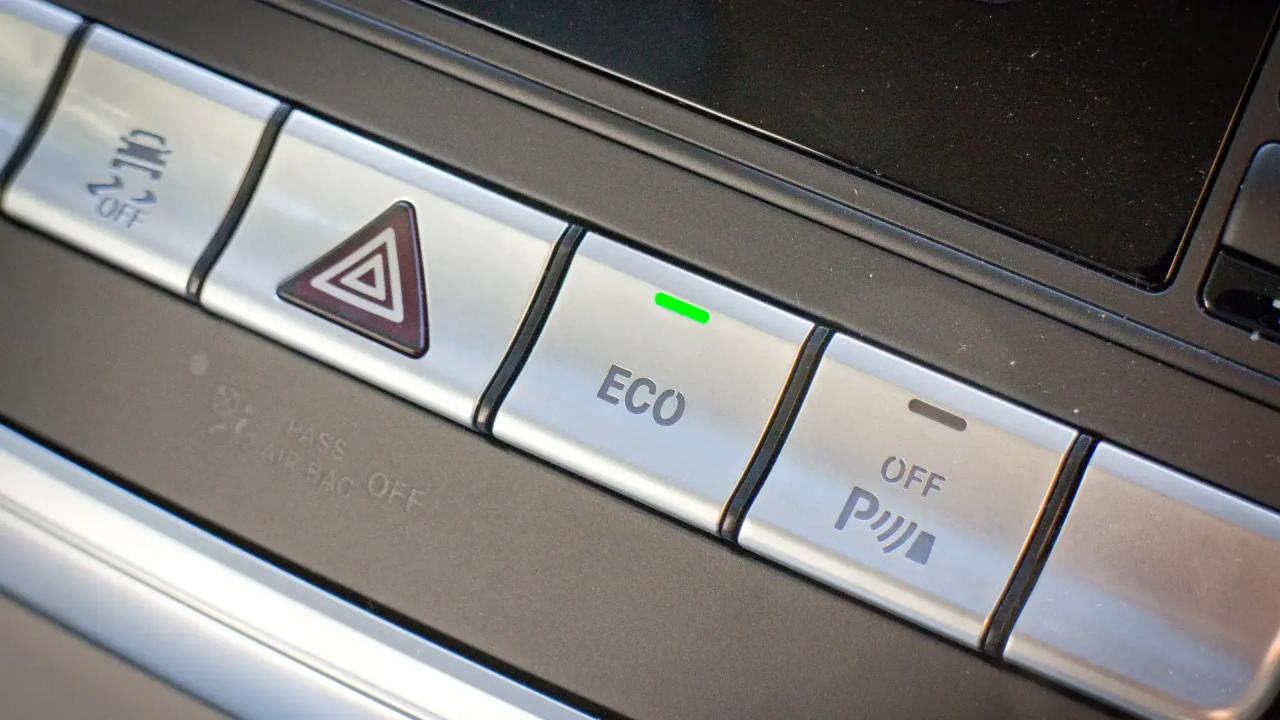
Eco mode is designed to improve fuel economy and often does in the right conditions. The changes it makes are real, but the benefit is usually modest and varies considerably between different cars. In practice, how you drive often matters more, and on motorways the dulled throttle response it produces can be more nuisance than help.
This article covers what the mode actually does, where it earns its keep, and where you can safely ignore it.
Key takeaways
- Eco mode is designed to save fuel. The changes it makes to throttle response and, in automatics, gear shift logic are real and can produce a small consistent improvement in the right conditions.
- What eco mode changes varies by car. In some vehicles it meaningfully adjusts throttle, gearing, and climate control; in others the practical effect is minimal. Check the owner’s handbook for your specific model.
- In manual cars, the benefit is smaller. Eco mode cannot change gear selection, so the driver’s own gear choices remain the dominant variable.
- The saving eco mode produces is typically modest and often only obvious over time rather than from one trip to the next. A driver who already drives smoothly gains less from it than one with a heavier throttle tendency.
- On motorways, eco mode’s dulled throttle response can be a responsiveness drawback when quick acceleration is needed. Switching out for those sections is sensible.
What eco mode actually changes: the systems it adjusts
Throttle response. The most consistent change across almost all implementations. The pedal-to-throttle mapping is adjusted so the same pedal press produces a smaller engine response. This makes the car feel slower to accelerate but naturally encourages gentler, more progressive inputs. It is both a mechanical change and a psychological nudge.
Gear shift logic (automatics). In automatics, Eco mode typically programmes the transmission to shift to higher gears earlier and hold those gears longer before downshifting. This keeps engine revs lower at a given speed, reducing fuel consumption during cruising. This is the most meaningful Eco mode change in an automatic. For the manual driver who wants to achieve part of this effect themselves, our article on when shifting earlier in a manual achieves part of what Eco mode does automatically covers the gear-choice approach.
Climate control. Many modern cars reduce the power available to the air conditioning compressor in Eco mode, or raise the temperature threshold before AC activates. This reduces engine load and can produce a modest but real saving in warm conditions. The trade-off is reduced cabin cooling.
Stop-start system. Some implementations make the stop-start system more aggressive, switching the engine off sooner at stops. This can increase the system’s fuel saving contribution in urban traffic.
Power delivery. In some cars, Eco mode reduces the maximum power available at a given throttle position. Combined with the throttle mapping change, the car simply accelerates more slowly.
Hybrid-specific. In hybrid vehicles, Eco mode may soften throttle response and reduce climate-control demand, but beyond that the behaviour is especially manufacturer-specific. Some hybrids may change how eagerly they use battery assistance, coast, or recover energy under braking, while others mainly alter throttle and climate settings. Because of that variation, it is safer to treat hybrid Eco mode as a model-specific feature rather than assume it always prioritises more EV running or stronger regeneration.
Eco mode functions vary by manufacturer and model. Check your owner’s handbook for specific details of what your car’s Eco mode activates.
System | What eco mode typically does | Fuel saving effect | Driver experience impact |
|---|---|---|---|
Throttle response | Softens pedal-to-engine mapping | Small to moderate, depends on driving style | Car feels slower to respond |
Gear shift logic (automatic) | Shifts up earlier, downshifts later | Moderate; holds lower revs during cruise | Smooth but less responsive |
Climate control (AC) | Reduces compressor power or limits AC activation | Small to moderate in warm conditions | Reduced cabin cooling |
Stop-start system | More aggressive activation | Small; most effective in stop-start traffic | No meaningful change for driver |
Power delivery | Reduces peak power availability in some cars | Small; mainly relevant under hard acceleration | Noticeably slower on demand |
Hybrid powertrain | May alter throttle, climate-control demand, and in some models battery assistance, coasting, or regenerative braking behaviour | Moderate; depends on driving pattern | Smoother low-speed operation |
When eco mode earns its keep
Urban stop-start driving. This is the best scenario for Eco mode. The softer throttle response discourages hard pull-away acceleration; the more aggressive stop-start saves fuel at every extended stop; and the climate control reduction may not be noticed in mild weather.
Moderate-speed A-road and mixed driving. At 30–60mph with moderate traffic, Eco mode’s effect on throttle response and (in automatics) gear selection produces consistent small savings. The reduction in peak responsiveness matters less because hard acceleration is rarely needed.
Drivers with heavier throttle tendencies. The benefit scales inversely with how smooth you already are. If you naturally tend to accelerate hard, Eco mode produces a more noticeable saving than for someone who already drives anticipatorily. For the smooth driver, Eco mode essentially enforces what they are already doing.
When eco mode helps less, or creates a trade-off worth knowing about
Motorway driving and overtaking. At sustained motorway cruise, Eco mode’s primary benefit is usually smaller because the engine is already working in a relatively efficient range. The trade-off is that if you need to accelerate to overtake, Eco mode’s dulled throttle response can make the car react more slowly than in Normal mode. For a brief, urgent overtake or a lane change requiring quick acceleration, this can be a real responsiveness drawback. Switching out of Eco mode for motorway sections where responsive performance may be needed is sensible.
Manual transmission cars. Eco mode cannot change gear selection in a manual. It may soften throttle response and limit some auxiliary functions, but the driver’s own gear choices remain the primary determinant of fuel economy. The benefit is smaller than in an automatic.
Performance-required scenarios. Any situation requiring urgent acceleration (merging onto a fast dual carriageway, overtaking in a tight gap) is a case where Eco mode’s reduced throttle response is counterproductive. Know how your car behaves in Eco mode before relying on it in a situation requiring quick responses.
Cold weather. In cold conditions, the engine’s warm-up phase already manages fuel mixture conservatively. Eco mode’s additional restrictions may produce minimal additional saving and could reduce comfort through climate control limitations when heating is genuinely needed.
Directional guidance for a typical modern petrol or diesel car. Hybrid behaviour may differ.
Condition | Eco mode verdict | Primary reason |
|---|---|---|
Urban stop-start traffic | Helpful | Throttle management and stop-start activation most effective |
Mixed A-road, moderate speeds | Helpful | Consistent small savings, no significant trade-off |
Steady motorway cruise | Marginally helpful | Limited additional benefit; AC saving may be relevant |
Motorway overtaking or quick acceleration | Not recommended | Dulled throttle response is a real responsiveness drawback |
Manual transmission car | Less helpful | Cannot change gear selection; limited system adjustment |
Cold weather | Marginally helpful | Climate control limits may reduce comfort |
Driver who already drives smoothly | Less helpful | Eco mode enforces what the driver does anyway |
The comparison that matters: eco mode vs how you drive
Eco mode is most useful as a corrective and reminder for drivers whose natural style tends toward heavier throttle inputs. For these drivers, the mode’s restrictions produce genuine savings by altering behaviour they would not otherwise change.
A driver who already drives smoothly, uses gentle progressive acceleration, anticipates braking situations, and avoids unnecessary speed changes, achieves much of what Eco mode attempts to produce through their own choices. For this driver, Eco mode’s additional benefit is small.
The practical implication: if you already tend toward smooth, anticipatory driving, the mode will add a small increment. If you tend to accelerate firmly and brake reactively, Eco mode will produce a more noticeable saving, and may also train you toward better habits even when it is switched off.
The practical recommendation: when to use it and when not to
For most urban and mixed driving: Eco mode is often worth leaving on. The likely fuel saving comes at the cost of some throttle responsiveness, but the practical effect in normal driving is usually acceptable. Urban and mixed driving is where it usually earns the most.
On motorways: if you are staying in one lane at a steady cruise, Eco mode has a small benefit and no meaningful drawback. If you are likely to need quick acceleration for overtaking or rapid lane changes, switch to Normal mode for those sections.
Manual car drivers: the benefit is smaller but there is no significant downside to leaving it on in urban use.
Testing it properly: one trip is not enough to measure. Run the same commute or route over several weeks with and without Eco mode and track a fuel log to see whether a difference is measurable in your specific car. You can measure whether Eco mode is making a difference to your real-world MPG with a simple fill-by-fill tracking method.
Keep reading
What Is a Good Petrol Price in the UK?
A good petrol price is one that is competitive for your area and station type, not just low against a national headline average. A price that looks expensive in a competitive super...
Do Older Cars Use More Fuel? How to Tell What’s Age, What’s Neglect, and What’s Fixable
Older cars often do use more fuel. But the reason is rarely just age. The most useful distinction is between genuine mechanical wear that accumulates over time, maintenance neglect...
Does Using a Higher Gear Save Fuel? When It Helps, When It Hurts, and What Actually Matters
Using a higher gear during steady cruising at the right speed does save fuel. The same gear at the wrong speed, engine struggling, throttle pressed further than it should need to…

PetrolSavings Editorial
Editorial Team
Explore fuel savings tools
Use calculators and local price searches to plan smarter journeys.
We check for new prices every 5 minutes. Every price shows when it last changed, so check that before comparing deals.