

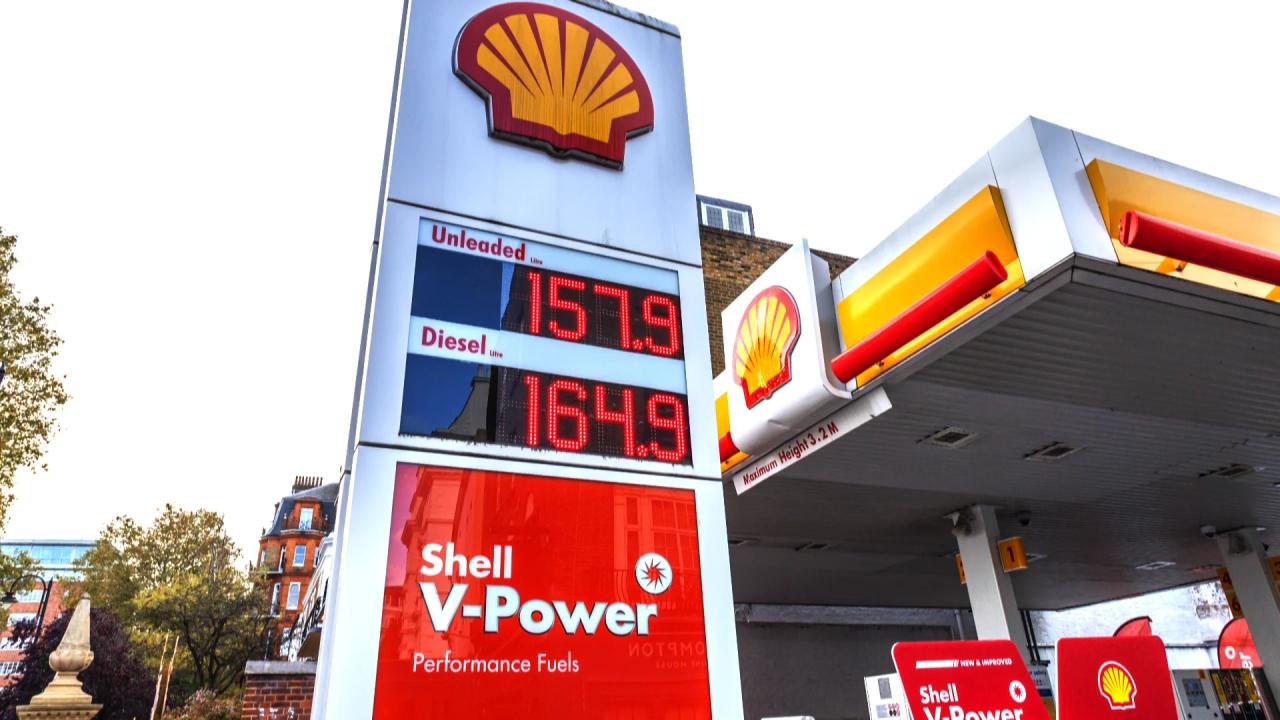
Oil prices drop. A Budget announces a duty freeze. Yet the number on the board at your local forecourt barely moves.
Part of the reason is structural: more than half of what you pay per litre is tax, and much of that tax does not move with oil markets. Strictly speaking, pump prices track wholesale refined fuel more directly than crude oil, but crude prices are the headline most drivers notice first.
That tax-heavy structure puts a floor under pump prices. Once you understand how that floor works, the slow response at the pump starts to make arithmetic sense, even if it is still irritating.
This article breaks down exactly what goes into the price of a litre, explains why a duty cut changes the pump price by less than many drivers expect, and identifies the most practical lever you can actually pull.
Key takeaways
- More than half the price of a litre of UK petrol is tax: fuel duty at a flat pence-per-litre rate, plus 20% VAT charged on the
- entire pump price including the duty itself.
- When duty is cut, the VAT charged on that duty also disappears. A 5p duty cut therefore reduces the pump price by about 6p if it is passed through in full.
- When wholesale fuel prices fall, the fixed tax portion does not move. That means a drop in crude oil or wholesale fuel does not translate one-for-one into a drop at the pump.
- Pump prices often rise faster than they fall. The Competition and Markets Authority has found both structural reasons for this and evidence of weakened competition in the UK road fuel market.
- The variable you can control most directly is which forecourt you use. The gap between the cheapest and most expensive stations in a given area is often several pence per litre.
What fuel duty is — and what it is not
Fuel duty is a fixed charge per litre, set by HM Treasury and applied before VAT. The current rate for both petrol and diesel is 52.95p per litre.
Duty rate as stated by HMRC as of 30 March 2026. Check the HMRC excise duty rates page for the latest figure.
It is a flat rate in pence, not a percentage. Whether crude oil is at $60 or $120 a barrel, the duty per litre is the same. It is set at the Budget and stays fixed until the Chancellor changes it. The most recent change was the temporary 5p cut introduced in March 2022 and extended at Budget 2025 until 31 August 2026.
Fuel duty is one of the UK government’s largest single revenue sources. The OBR publishes forecasts for fuel duty receipts after each fiscal event. What it is not: a windfall levy on oil companies, a percentage tax that grows with the price, or something that adjusts automatically when markets move.
What actually goes into the price of a litre
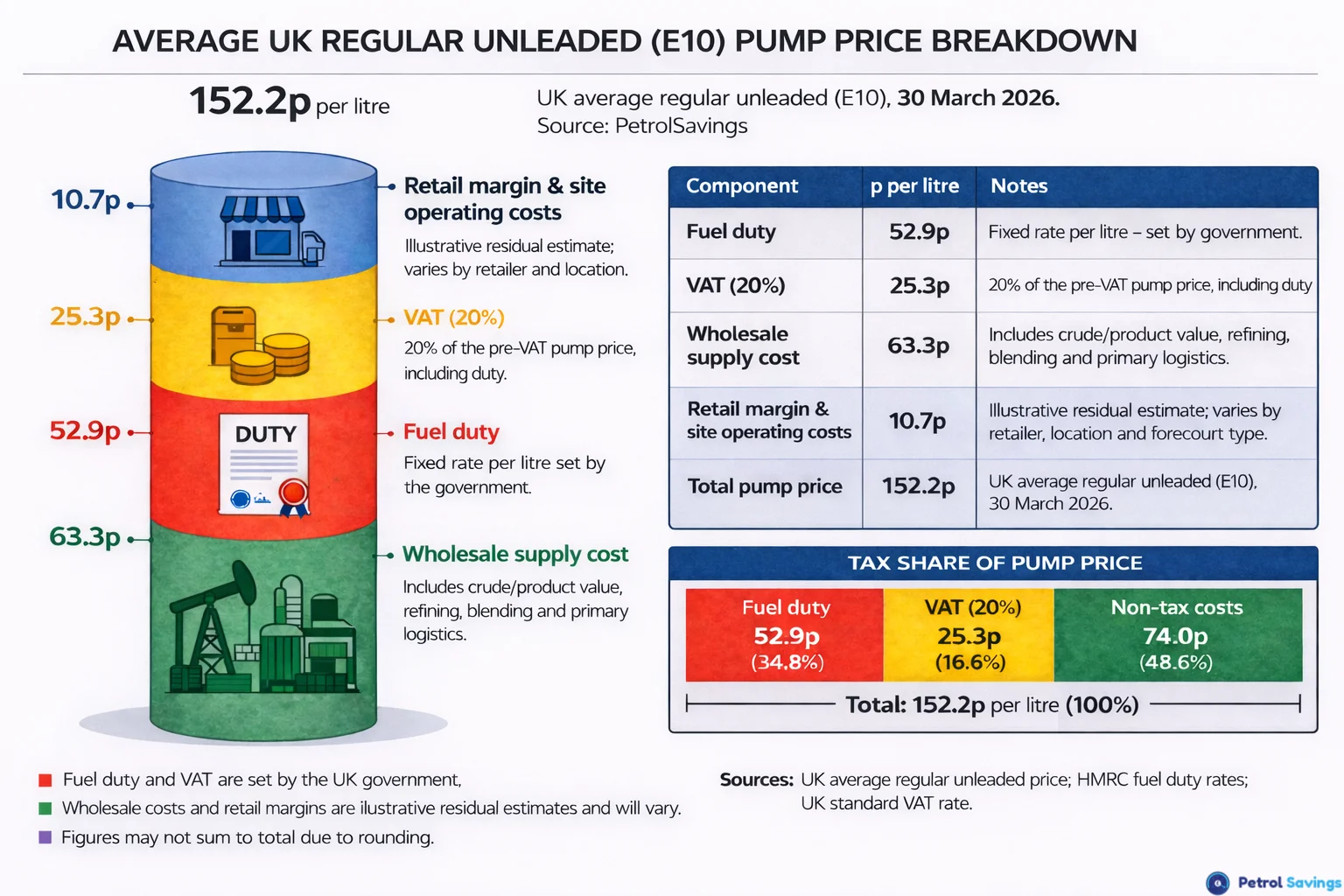
Four components make up the number on the forecourt board: the wholesale cost of refined fuel, fuel duty, VAT, and the retailer’s margin plus distribution costs. Official GOV.UK weekly road fuel prices data publishes average pump prices, but the breakdown below uses a PetrolSavings UK average unleaded price for 30 March 2026. The breakdown below shows how those components stack up.
Figures based on PetrolSavings UK average unleaded pump price of 152.2p as of 30 March 2026. Sources: PetrolSavings UK average unleaded price; HMRC excise duty rates; UK standard VAT rate. Wholesale cost and retail margin are illustrative residual estimates and exact retailer margin varies.
Component | Approx. p/litre | Notes |
|---|---|---|
Fuel duty | 52.9p | Fixed rate per litre — set at Budget |
VAT (20%) | 25.3p | Charged on duty + wholesale + margin |
Wholesale cost | 63.3p | Approximation — moves with oil markets and refining costs |
Retailer margin + distribution | 10.7p | Approximation — varies by forecourt type |
Total pump price | 152.2p | PetrolSavings UK average regular unleaded (E10), 30 March 2026. |
The structural point is in the proportions. Duty and VAT together account for well over half the total. When wholesale prices fall, they reduce only the non-tax portion of your pump price. That is why a large drop in crude translates into a much smaller drop at the forecourt.
You can see what makes up the price of a litre using the PetrolSavings price breakdown calculator, which shows the current split between duty, VAT and wholesale cost.
Why a 5p duty cut changes the pump price by about 6p
This is the mechanism most people miss. VAT is charged on the full pump price, and that full price includes the fuel duty. So, duty and VAT are not simply added side by side, VAT is charged on top of the duty. When duty is cut, the VAT that was being charged on that duty disappears too.
That sounds like a bonus. In one sense it is: a 5p duty cut actually reduces the pump price by about 6p, because the 1p of VAT on that 5p also falls away. But the effect in the other direction is why pump prices feel sticky.
Worked example (illustrative):
Take a pump price of 152.2p per litre. If fuel duty were cut by 5p:
The duty saving is 5p per litre
The VAT previously charged on that 5p was 1p (5p × 20%)
Total reduction at the pump: 6p per litre
On a 152.2p pump price, that 6p is a reduction of roughly 3.9%
Illustrative, based on a duty cut of 5p per litre and a 20% VAT rate, using a PetrolSavings UK average unleaded price of 152.2p per litre as of 30 March 2026.
Even if every retailer in the country passed the cut through immediately and in full, the pump price would only fall by the duty amount plus the VAT on it. Not by the duty amount applied proportionally to the whole price. This is not profiteering. It is how a fixed tax interacts with a percentage tax.
Why prices rise faster than they fall
Most drivers have noticed the pattern: pump prices shoot up when oil markets spike, then drift down slowly when they retreat. The Competition and Markets Authority examined this asymmetry in its 2023 road fuel market study.
Part of the explanation is structural. When wholesale prices rise, a retailer’s next delivery can cost more immediately. When wholesale prices fall, stations may still be selling through stock bought at higher prices, so cuts at the pump can lag.
But that is not the whole story. The CMA found that competition in the UK road fuel market had weakened since 2019, that margins had risen, and that diesel drivers in particular paid materially more in 2023 than they would have in a more competitive market. So the lag is real, part of it is structural, and part of it can also reflect slower pass-through in a weakly competitive market. The fixed tax floor amplifies the effect by reducing the share of the pump price that can move at all.
What this actually means for your weekly fill
The tax floor changes the arithmetic of oil-price watching. If roughly half the pump price is fixed, a fall in crude oil or wholesale fuel prices affects only the non-tax portion of what you pay. That is why pump-price moves are usually smaller than the oil headlines suggest.
Put it another way. If the underlying non-tax cost falls by 5p per litre, the pump price can fall by about 6p if that change is fully passed through, because the VAT charged on that 5p falls away as well. On a pump price of 152.2p, that is a reduction of roughly 3.9%.
The practical implication is that tracking Brent crude is only a rough guide to when forecourt prices may move. What usually matters more to your bill this week is which forecourt you choose. The gap between the cheapest and most expensive stations within a few miles of each other is often larger than the effect of any single recent wholesale move.
You can check what forecourts near you are charging right now, the price difference between stations is the one variable you control completely.
Misconceptions worth clearing up
“Oil companies set the pump price”
Not in the way most people mean. Refiners sell wholesale fuel on global markets. The pump price is set by the forecourt operator, whether that is a supermarket chain, an independent dealer or a branded franchise. Fuel duty and VAT are set by the government. The wholesale price moves with global oil and refining markets. No single entity controls the number on the board.
“The government makes more money when pump prices are high”
Partly true, and worth being precise. Fuel duty is fixed per litre, the Treasury collects the same whether prices are high or low. But VAT is 20% of the full pump price. When prices rise, VAT revenue rises with them. This is how ad valorem tax works. It is not a hidden mechanism; it is built into the structure.
“A duty freeze means prices stay the same”
A duty freeze means the rate does not increase. It does not lock pump prices in place. Wholesale costs, refining margins and retailer pricing all continue to move. A freeze prevents a specific additional cost, the scheduled duty rise that would otherwise have happened, but it does not freeze anything else.
“Cutting fuel duty makes no difference because retailers pocket it”
This is too strong as a blanket claim, but the opposite extreme is also misleading. The CMA’s work shows that pass-through and competitive pressure do matter, and that UK road fuel competition has weakened in recent years. In general, duty changes do affect pump prices, but the timing and completeness of pass-through can vary. The clearest way to put it is that a duty cut does make a difference, but the visible saving is smaller than many people expect because of the tax arithmetic described above, and market conditions can affect how quickly savings reach drivers.
What to watch and where to check
Duty changes happen at Budgets and Autumn Statements. The HMRC excise duty rates page shows the current rate and any recent changes.
Wholesale price movements are published weekly by GOV.UK alongside average pump prices. The gap between the two is a rough proxy for the combined tax and margin component.
The OBR publishes fuel duty revenue forecasts after each fiscal event, useful if you want to understand the government’s own projections for how much this tax raises.
For the thing that actually affects your bill this week: the price at your nearest forecourt. Use the PetrolSavings price breakdown calculator to see how the current pump price splits between duty, VAT and wholesale cost.
Keep reading
Is There a Cheapest Day to Buy Petrol in the UK? What the Data Really Shows
There is no reliably cheapest day to buy petrol in the UK. Some analyses have suggested limited midweek softening in parts of the market under stable conditions, but the effect…
The Real Cost of Driving 10,000 Miles in the UK: Fuel Is Only Part of the Answer
At 10,000 miles a year, a realistic all-in running cost for a typical used petrol family car in the UK is about £4,800 to £5,200 once you include fuel, insurance, servicing, tyres,...

How to Calculate Fuel Cost Per Mile for Petrol, Diesel, Hybrids and EVs
Most drivers know roughly what they pay at the pump. Far fewer know what one mile of driving actually costs in fuel or electricity.

PetrolSavings Editorial
Editorial Team
Explore fuel savings tools
Use calculators and local price searches to plan smarter journeys.
We check for new prices every 5 minutes. Every price shows when it last changed, so check that before comparing deals.