

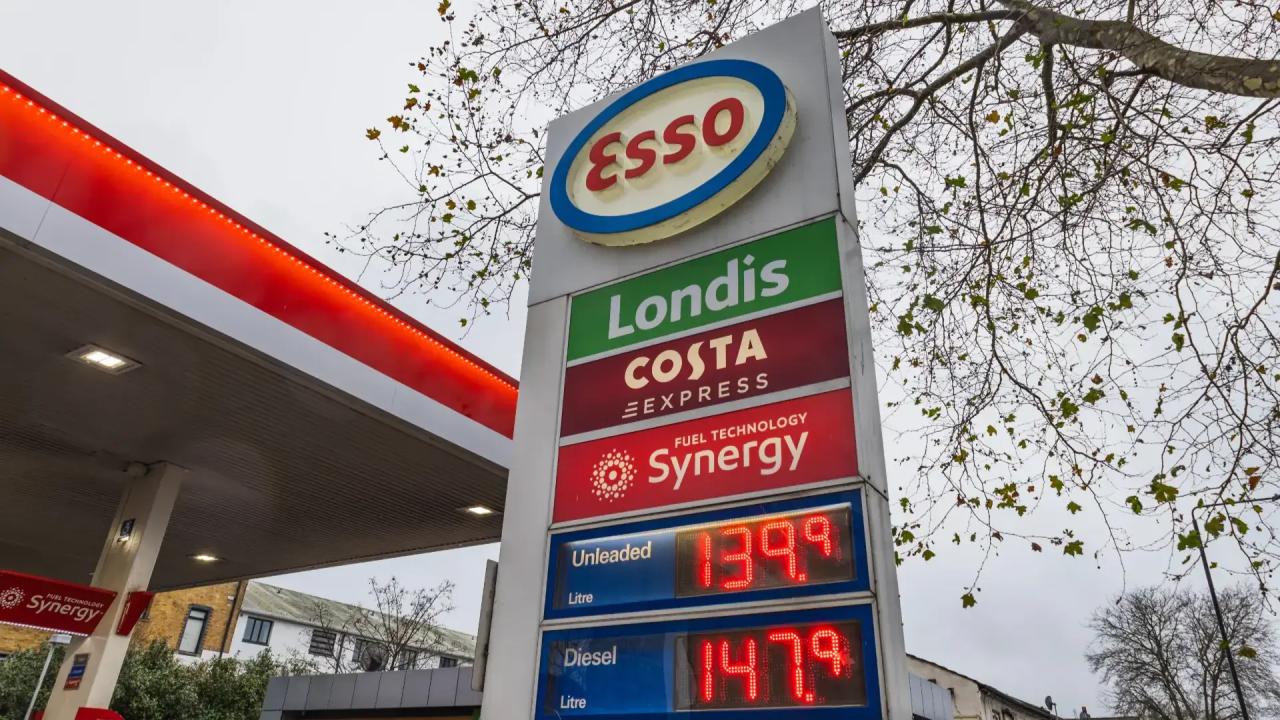
A UK forecourt price board takes about five seconds to read correctly, but there are three things most drivers scan past that make that reading wrong more often than it should be.
These are the sub-penny decimal that makes every price look lower than the rounded whole-penny figure people anchor to, the font size hierarchy that buries part of the number, and the way stacked displays can make it unclear which line belongs to the fuel you want.
This article covers all three and ends with a quick reference you can apply at any forecourt before pulling in.
Key takeaways
- UK forecourts normally display fuel prices in pence per litre, usually to a tenth of a penny: 141.9p is the standard format. That convention makes a displayed price look slightly lower than the rounded whole-penny equivalent.
- Font size hierarchy on many price boards makes the leading digits visually larger than the decimal, a board showing “141” in large text with a small “9” reads as “141-something” at a glance, not as “nearly 142p.”
- Stacked multi-grade displays place E10 petrol, E5 Super Unleaded, B7 diesel, and premium diesel on separate lines. Reading the wrong line is a reliable misread, particularly at approach speed.
- E10 is the standard petrol grade at UK forecourts since September 2021. E5 (Super Unleaded) is a separate, typically more expensive product. Knowing which line is which matters before comparing prices.
- Price boards are a useful quick filter but not a substitute for checking PetrolSavings before arrival. They are harder to read accurately at speed, and if any sign, board, pump or online listing appears inconsistent, check the pump price and ask before dispensing.
What a UK forecourt price board actually shows
UK forecourts normally display fuel prices in pence per litre. In practice, the important price for the driver is the per-litre price shown for the relevant fuel before you dispense. A roadside price board is common, but it is not the only place price information appears, and the pump display is the one to check before lifting the nozzle.
A standard board shows between two and five fuel grades, usually stacked vertically. Each line shows the fuel grade name or abbreviation and the price in pence per litre. Some sites also show AdBlue pricing.
The format for each price is usually three digits for the pence, a decimal point, and one digit for the fraction of a penny: 141.9p. That is the usual UK forecourt format.
Typical UK price board layout (top to bottom): E10 Unleaded - [price] / Super Unleaded (E5) - [price] / Diesel (B7) - [price] / Premium Diesel - [price]. Order varies by site. Always read the label, not just the position.
The sub-penny decimal: the convention every driver should know
UK forecourts usually quote fuel prices to one decimal place, a tenth of a penny. The price is almost never a round number: 141.9p is standard; 142.0p is less common. The displayed price is therefore fractionally below the nearest whole penny.
The perceptual effect is consistent: 141.9p reads more like 141 than 142 at a glance, because the eye captures the first three digits before the decimal. This mirrors the .99 pricing convention across retail, the price anchors to the lower round number in fast visual processing.
The practical skill: always read the full number including the decimal digit before comparing. A board showing 141.9p and a board at the next station showing 143.9p are 2p per litre apart. At a 50-litre fill, that is £1.00. Both read as “one-forty-something” at approach speed, the difference is in the digit before the decimal, and it is worth reading correctly.
Font size hierarchy: why the big number is not always the whole price
Many UK forecourt price boards, particularly illuminated LED or backlit panel boards, display the pence figure in a larger font than the decimal. A common format shows “141” in large digits with “9” in a noticeably smaller superscript. The visual effect: the prominent number is 141. The full price is 141.9p.
Some boards go further: the decimal digit appears in a smaller font, a different colour, or a different vertical position. Any of these reduces its visual prominence. At the distance and speed of a road approach, the driver sees the large digits first and may not consciously register the smaller one.
This is a documented retail display technique. It is not automatically unlawful, provided the price remains unambiguous, easily identifiable and clearly legible in a clear font of reasonable size. Not all forecourts use it; many display all digits in equal size. The skill is worth having for those that do.
Multi-grade displays: reading the right line for your fuel
Most UK forecourt price boards display multiple fuel grades in a stacked vertical layout. The reader’s eye naturally goes to the most prominent number first, which may or may not be the fuel they intend to buy. On a four-line board with prices ranging from, say, 141.9p for E10 to 174.9p for premium diesel, a quick scan of the wrong line gives a significantly wrong price expectation.
The grades to know: E10 Unleaded is the standard petrol grade at almost all petrol stations in the UK and is usually the cheaper of the two unleaded options. E5, marketed as Super Unleaded or Premium Unleaded, is the higher-octane alternative and is usually more expensive. B7 Diesel is the standard diesel. Premium Diesel (V-Power, BP Ultimate, and similar) is the most expensive line.
If you drive an older petrol car and are unsure whether it can use E10, check GOV.UK’s E10 vehicle checker before filling. If your vehicle is not compatible, use E5 super.
The misread risk: a driver wanting B7 diesel who reads the E10 price, or a driver wanting E10 who reads the premium diesel line. The practical skill: identify which line corresponds to your fuel type before reading the price. Check the label, not just the position.
The approach-speed problem: why boards are not reliable price sources
A driver approaching a forecourt at 20–30mph on a busy road is reading a price board at distance, under time pressure, while deciding whether to indicate and pull in. The reading conditions are the worst possible for catching a sub-penny decimal, a smaller font digit, or a misaligned grade line.
The display conventions that make prices read slightly lower than they are, sub-penny decimal, font hierarchy, are most effective at exactly the reading distance and speed of approach. Price boards are a useful fast filter: they can tell you whether a forecourt is in the right price range. They are not a reliable substitute for checking prices before you leave, which means knowing the correct full price at your target station before you approach it.
Specific display techniques worth recognising
The “from X” board: Some forecourts, particularly service area approach signage, display a single prominent “from Xp” price, which corresponds to the cheapest available fuel. A diesel driver seeing “from 141p” who arrives to find diesel at 153p has been technically correctly informed but practically misled. “From” means the cheapest grade, which may not be yours.
The price not yet updated: Forecourt prices can change during the trading day. Since 2 February 2026, sites reporting to the government’s Fuel Finder service have had to submit price updates within 30 minutes of any change. Even so, online listings or approach signage can still lag a recent update. If the pump price differs from the board price or an online listing, check before dispensing rather than assuming the lower number applies.
Conditional pricing notices: If a site advertises a price subject to conditions, for example a clearly labelled loyalty price or another qualifying notice, those conditions should be shown prominently before you buy. Since 2018, businesses generally cannot add a surcharge for paying with a personal debit or credit card, though special cases can still arise outside ordinary consumer card payments. For most drivers at major forecourts, the displayed price should be the price they pay.
Know your rights at the pump
You are entitled to know the displayed price and any material condition before you buy. If a forecourt advertises a loyalty price, a “from” price, or another conditional price, that condition should be shown clearly before you commit.
If the board, pump and grade label do not match, stop and ask before lifting the nozzle or before dispensing fuel. It is much easier to sort out a discrepancy before fuel goes into the tank than after.
If a station’s published Fuel Finder price looks wrong, you can report a discrepancy through GOV.UK’s fuel-price error reporting route. That is useful where the online listing appears to be out of date or does not match the forecourt details being shown.
Self-service vs attended service
Attended service bays are rare in the UK, but they still exist at some rural or older sites. Where they do, there may be a small additional charge for attended service. This is not a display trick, but it is another reason to read the wording on the board carefully. If a site offers both, check whether the displayed price is specifically marked as self-service.
The five-second scan method
Before pulling in:
Identify the grade line for your fuel, not the top line or the most prominent number, the line labelled with your fuel type
Read the full price including the decimal, 141.9p is not 141p; the digit after the decimal is part of the price
Check whether the display shows a “from” price, if it does, the price for your grade may be higher
Look for any condition attached to the displayed price, such as a “from” price, a loyalty condition, or a clearly stated self-service or cash-only notice
Confirm the grade and price again on the pump before lifting the nozzle; if anything looks unclear, ask before pumping
Common misreads and what causes them
Reading the E10 price when intending to buy diesel, the top line is not always the relevant one
Reading “141” as the full price when the board shows “141.9”, the decimal matters
Treating the prominent “from” price as the price for your fuel, it is the cheapest available grade
Assuming every sign, board and online listing will update at exactly the same moment, recent price changes can create short-lived differences, so check the pump price before dispensing if anything looks inconsistent
Comparing two forecourt prices at approach speed and missing a 2p per litre difference because both read as “one-forty-something”
Assuming the cheapest number visible on a multi-grade board is the price for B7 diesel, it may be E10 petrol
Keep reading
Local Fuel Disruption: What to Do, Where to Look, and Why Panic Buying Makes It Worse
An empty forecourt is an inconvenience, not an emergency, unless your tank is already very low. Most localised fuel disruptions in the UK resolve within hours or a few days, and…
How Petrol Is Made: What Actually Happens Between the Oil Well and the Forecourt Pump
Petrol does not come out of the ground ready to use. Crude oil is a mixture of hydrocarbons that must be separated, chemically upgraded, and precisely blended before it becomes the…

Where Does UK Petrol Come From? The Supply Chain from Oil Field to Forecourt
The petrol at your forecourt comes from a combination of crude oil refined in the UK and refined product imported from overseas. Some of that crude is UK North Sea production, but...
PetrolSavings Editorial
Editorial Team
Explore fuel savings tools
Use calculators and local price searches to plan smarter journeys.
We check for new prices every 5 minutes. Every price shows when it last changed, so check that before comparing deals.