

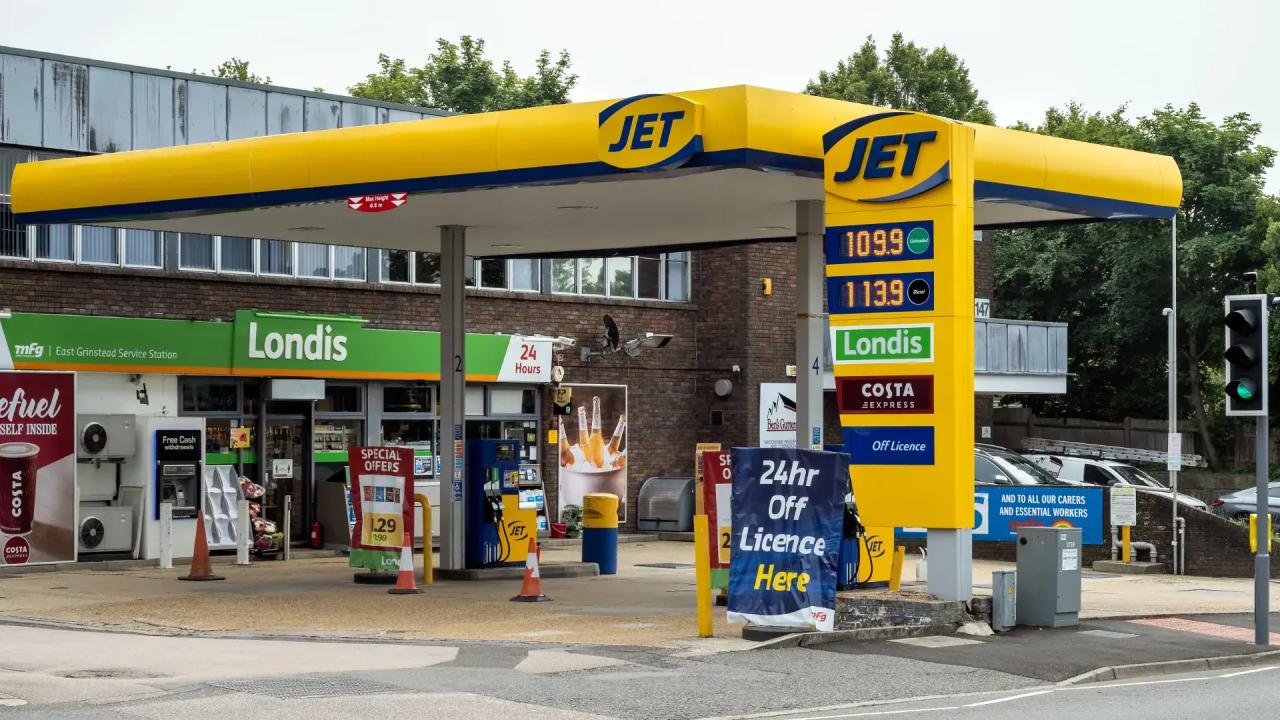
Two petrol stations visible from each other can still charge prices that differ by 8p a litre. It is not an illusion. Local fuel-price variation in the UK is real, persistent and larger than most drivers expect.
It is also not explained by a single cause. Competition intensity, wholesale supply contracts, site costs, brand pricing arrangements, and captive demand near major roads all play a role.
This article explains each factor and ends with practical tools that help you make the variation work for you rather than against you.
Key takeaways
- Local fuel-price variation reflects several structural factors that interact differently at each site: competition, supply contracts, site costs, brand agreements and captive demand. No single explanation covers all cases.
- Captive demand near motorway junctions and major A-road services is the primary explanation for the largest premiums. Stations in these locations face less price-sensitive demand and price accordingly.
- Supermarket forecourts are frequently among the cheapest in any area, partly because fuel drives footfall to the main store. This is directional, not universal: some independents undercut them locally.
- Tied forecourts operating under brand supply agreements have less pricing flexibility than independents buying on the open wholesale market. This is why the same brand can charge different prices at different sites.
- The gap between the most and least expensive station within a few miles of most UK drivers is typically larger than any saving from driving technique. Checking prices before filling up is often the highest-return action available.
Five factors that set a forecourt’s price
Competition intensity. A forecourt surrounded by three competitors within half a mile faces genuine price pressure. One with no nearby alternatives, on a rural A-road, near a ferry port, at a motorway junction, does not. Where competition is strong, prices converge toward the local floor. Where it is weak, they drift upward. This is the most fundamental factor and the one that explains the broadest patterns. You can see how prices vary across the UK to see the geographic spread for yourself.
Wholesale supply contracts. Most branded forecourts are tied to a specific fuel supplier under a supply agreement that sets the wholesale price and may influence the retail price. An independent forecourt buys on the open wholesale market and has more freedom to shop around. When wholesale prices fall, an independent can pass on the reduction faster; a tied forecourt’s pace of pass-through depends on its contract terms. This is why two stations of different ownership can charge different prices even when their operating costs look similar.
Site operating costs. A forecourt on a prime arterial road in central Birmingham pays more in land rent, business rates, and infrastructure costs than one on a quiet road on the edge of a market town. These fixed costs are recovered through the retail margin. A visible price premium at a high-footfall urban site may partly reflect real cost differences, not purely a discretionary margin decision.
Brand pricing agreements. Major fuel brands negotiate supply and branding agreements with individual forecourt operators. These vary: some include recommended retail prices, some include volume commitments, and some include marketing support tied to pricing behaviour. The result is that the same brand's fuel can be priced differently at different sites, partly reflecting the terms of individual agreements and partly reflecting local competitive conditions.
Captive demand. Drivers who are low on fuel and have no realistic alternative will pay the prevailing price. This is the factor that explains the most extreme premiums: motorway services, remote rural sites, tourist-area stations where the next forecourt is 20 miles away. These stations are pricing to a market where demand is less price-sensitive. Understanding this makes it predictable, and avoidable.
One important distinction: the price the customer pays is not the same as the profit the retailer makes. The retail margin on fuel is typically only a few pence per litre; most of the pump price is made up of wholesale fuel cost, duty and VAT. A station charging 10p per litre more than a competitor is not necessarily making 10p per litre more in profit. It may have higher site costs, a different supply arrangement, or be recovering a below-cost period elsewhere.
Why location is the biggest single variable
The most dramatic local price premiums in the UK are almost always location-driven. Motorway service stations, A-road services in areas with long distances between alternatives, and forecourts at major tourist gateways, ferry terminals, national park entry roads, remote highland routes, all command premiums that are not explained by cost differences alone.
The mechanism is simple: a driver at 15% fuel gauge and 30 miles from the next potential station is not a price-sensitive buyer. They will pay the price on the forecourt. The operator prices to that reality. The spread between motorway services and the cheapest nearby alternative is persistently large, typically 10p per litre or more, sometimes considerably more.
Real UK examples: the M6 services between junctions 16 and 15 southbound, the A9 services in Highland Perthshire, the A30 in Cornwall approaching Penzance. At each, drivers with limited range and no nearby alternative pay a premium that drivers who filled up 30 miles earlier avoid entirely.
The practical implication is simple: captive-demand pricing is predictable. If you can see the situation coming - a long motorway run or a rural route with sparse stations - you can fill up before you reach the premium zone. Planning the fill is the defence.
Why supermarkets are often but not always cheapest
Supermarket forecourts use fuel pricing as a competitive tool to drive footfall to the main store. Cheaper fuel attracts customers who then spend inside. The economics of fuel as a thin-margin or loss-leader product are different from a standalone forecourt that must recover all costs through the fuel price alone.
Their scale also helps. Large supermarket groups buy fuel in volumes that smaller operators cannot match, giving them lower wholesale costs. These advantages are structural, supermarket forecourts have been among the cheapest in most UK markets for years, and the CMA’s fuel retail market review found this to be a consistent pattern.
The exception: in some areas, competitive independent forecourts match or undercut supermarket prices. In rural areas without a nearby supermarket forecourt, the cheapest option may be an independent. Price checking rather than brand assumption is the reliable approach.
Does the brand on the pump matter?
Base petrol and diesel sold in the UK must meet minimum European standards, BS EN 228 for petrol, BS EN 590 for diesel. All fuel sold at UK forecourts meets these standards regardless of brand or price.
Major fuel brands - Shell, BP, Esso and Gulf - add proprietary additive and detergent packages to the base fuel. They claim these improve engine cleanliness and long-term protection. The strength of those claims varies, and independent evidence is limited. For most modern cars on most journeys, the real-world performance difference between branded and unbranded fuel is not clearly established. For older vehicles or high-performance engines, some manufacturers do recommend branded or premium fuel specifically, so check the owner's manual.
The price premium for branded fuel is real. Whether it is worth paying depends on your car and your driving. For most drivers, the honest answer is probably not, but the evidence base is not definitive enough to state that categorically. Compare fuel brands to see how branded and unbranded prices sit in your area.
What the CMA found — and what it did not
The Competition and Markets Authority investigated the UK road fuel retail market and found evidence of asymmetric pricing: pump prices tend to rise more quickly when wholesale costs increase than they fall when wholesale costs decrease. This is documented, attributed, and matches the experience of watching prices jump 5p overnight and then drift down 1p at a time over the following weeks.
The CMA also identified concerns about market transparency and recommended measures to improve price information for consumers. The Fuel Finder open data scheme, which requires major retailers to publish live forecourt prices, was developed partly in response to these recommendations.
What the CMA did not conclude is that all local price variation is explained by retailer opportunism, or that the market operates as a cartel. The structural factors - competition, contracts, site costs and captive demand - are real and acknowledged. The asymmetric pricing behaviour is documented on top of those structural factors, not instead of them.
What you can do about it
Check before you leave. Check nearby forecourt prices before setting off. A live price tool makes it easier to compare the nearest station with cheaper alternatives within a few miles, using data from the government's Fuel Finder scheme. A driver who knows the cheapest station near their route before leaving can factor that into the journey from the start.
Predict the premium by location type. Motorway services: expensive, plan to leave the motorway if range allows. Rural A-road services with no nearby alternative: likely a premium, fill before reaching them. Tourist gateway towns in summer: prices typically higher in peak season. Urban roads with visible competition: likely closer to the local market floor. This is not a guarantee but it is a reliable working model.
Use the supermarket rule as a starting point, not a guarantee. Supermarket forecourts are a reasonable first approximation for lower prices. But check first: the cheapest station in a given area on a given day may be an independent, and prices move with wholesale costs.
Combine habit and tool. Fill up before the gauge drops low enough to force a decision at a premium site. Check prices before leaving, not at the pump. Together, those two habits remove much of the captive-demand premium from annual fuel spending.
Keep reading
Is There a Cheapest Day to Buy Petrol in the UK? What the Data Really Shows
There is no reliably cheapest day to buy petrol in the UK. Some analyses have suggested limited midweek softening in parts of the market under stable conditions, but the effect…
The Real Cost of Driving 10,000 Miles in the UK: Fuel Is Only Part of the Answer
At 10,000 miles a year, a realistic all-in running cost for a typical used petrol family car in the UK is about £4,800 to £5,200 once you include fuel, insurance, servicing, tyres,...

How to Calculate Fuel Cost Per Mile for Petrol, Diesel, Hybrids and EVs
Most drivers know roughly what they pay at the pump. Far fewer know what one mile of driving actually costs in fuel or electricity.

PetrolSavings Editorial
Editorial Team
Explore fuel savings tools
Use calculators and local price searches to plan smarter journeys.
We check for new prices every 5 minutes. Every price shows when it last changed, so check that before comparing deals.