

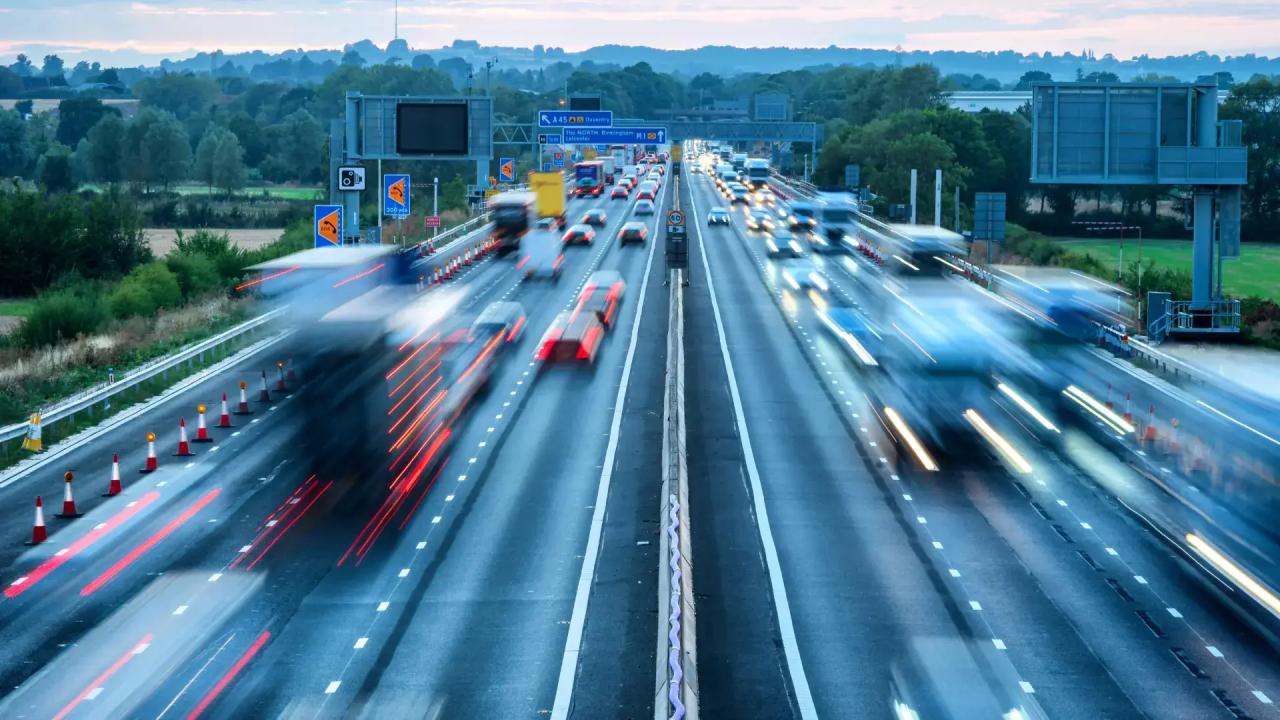
Bank holiday congestion adds to your fuel bill in three ways: idle burn in stationary traffic, higher prices at motorway services when your tank is low, and fuel used on detours that may themselves be slow.
The first gets most of the attention. The second costs most people the most money. All three are largely avoidable if you know when to act.
Key takeaways
- Stationary and stop-start traffic burns fuel continuously, but for most bank holiday journeys, the motorway service premium costs more in total than the idle burn. A tank filled at a motorway services can cost significantly more than one filled at a local forecourt the night before.
- The most valuable single action before a bank holiday trip is filling up at a local forecourt on Thursday evening or early Friday morning, before forecourt queues lengthen and before the motorway price becomes your only option.
- The August bank holiday Friday and Monday are among the busiest travel days on UK roads. Easter Friday is comparable. The May bank holidays generate meaningfully less traffic. Timing decisions should reflect which bank holiday it actually is.
- Detours to avoid congestion are only worth their fuel cost if the alternative route is genuinely faster, not just theoretically shorter. On peak days, popular A-road alternatives are frequently as congested as the motorways they are meant to replace.
- A car with factory stop-start already mitigates idle fuel burn in stationary queues. The bigger saving is always in where you fill up, not in what happens in the queue.
Why bank holidays cost more in fuel — the three mechanisms
Three things drive higher fuel spend on a bank holiday road trip. First: congestion. Stop-start driving burns more fuel per mile than free-flowing driving because the engine is repeatedly accelerating the car rather than maintaining momentum.
Second: motorway service pricing. Service stations on major routes price fuel significantly above the national average, and drivers who join a motorway without filling up often reach a services with a low tank and no alternative. This is consistently the largest single extra cost for most bank holiday drivers.
Third: detours. Drivers who leave the main route to avoid congestion add distance. If the alternative is also slow, they incur both the extra mileage and the stop-start penalty.
Before you leave: when to fill up
Forecourts near motorway junctions and in suburban areas experience high demand on bank holiday Friday mornings. Queues at popular supermarket forecourts build from mid-morning and are longest in the early afternoon. A driver who intends to fill up before the motorway but delays until Friday lunchtime may face a 15-minute queue and miss the window before motorway congestion sets in.
The correct timing: fill up Thursday evening, or Friday morning before 8am. A full tank removes the service station pricing risk entirely for most journeys. For longer trips requiring a mid-route fill, the evening-before fill at least means departing with a full tank and the option to refuel at a destination forecourt rather than on the motorway.
Check forecourt prices on your route before you leave. A two-minute check before departure can save more than any driving-habit change on the road.
Worked example (illustrative):
At 140.9p per litre, filling a 55-litre tank at a local forecourt costs approximately £77.50. The same fill at a motorway services priced at 172.9p per litre costs £95.10, a difference of £17.60 for one fill. On a family round trip requiring two fills, that difference doubles to £35.20.
Figures based on 140.9p/litre at forecourts vs 172.9p/litre at motorway services, as of 24 March 2026. Check current prices at specific services on your route.
Before you leave: timing your departure
The August bank holiday generates the highest traffic volumes of any UK bank holiday, with the Friday preceding the Monday consistently ranking among the busiest travel days on UK roads. The peak window on the Friday is typically mid-morning through mid-afternoon. Departing before 8am or after 7pm on a major bank holiday Friday significantly reduces exposure to peak congestion on major routes.
Easter Friday is comparable in traffic volume. Early May and late May bank holidays usually generate substantially less traffic, so timing matters slightly less on those weekends.
National Highways and the RAC publish travel forecasts in the week before major bank holidays, check National Highways travel updates for the specific dates you are travelling.
An earlier or later departure does not just save time. It reduces total congestion exposure, which reduces idle burn and reduces the probability of arriving at a motorway services with a low tank and no choice. The fuel saving from departing at 7am rather than 11am on an August bank holiday Friday is indirect but real.
What queues actually cost in fuel
A stationary engine in a traffic queue burns fuel at idle, continuously but at a modest rate. On a car with factory stop-start, the system cuts the engine during prolonged stops, mitigating this. On a car without stop-start, the idle burn runs uninterrupted.
Congestion meaningfully increases fuel consumption per mile compared to free-flowing motorway driving. But the larger cost is not pure idling, it is repeated acceleration from low speed. Stop-start urban driving uses significantly more fuel per mile than steady cruising. The cumulative effect across multiple congestion periods on a 200-mile bank holiday run is meaningful, but it is driven primarily by the driving pattern, not by stationary time.
If you are stuck in a long stationary queue and the car has factory stop-start, leave the system active. It is designed to handle this efficiently. If the car does not have stop-start and the queue is clearly stationary for more than a short pause, switching off can make sense.
On the road: detours — when they help and when they do not
A detour is worth its fuel cost only if the time and distance saved on the alternative route offset the extra miles driven. This calculation requires live traffic data, not an assumption that A-roads are automatically faster than motorways on a bank holiday.
On a major bank holiday Friday or August Monday, A-road alternatives to the M5, M4 and M6 in particular are frequently as congested as the motorway, because many drivers have the same idea simultaneously. A detour via the A303 to avoid the M3 may save nothing if the A303 is stationary near Stonehenge.
Use a live navigation tool with traffic data enabled, Google Maps, Waze, or similar, rather than pre-planning a fixed alternative route. If the live data shows the alternative is faster by more than 10–15 minutes for equivalent distance, the detour is likely worth taking. If the time saving is marginal, the extra miles add fuel cost without meaningful benefit.
Three myths about bank holiday fuel costs
“Sitting in traffic for an hour costs a lot in fuel”
The idle burn during a stationary queue is real but modest. The engine runs at low load, so fuel consumption at idle is only a fraction of what it is under driving load. The much larger fuel cost on a bank holiday usually comes from the motorway-service premium. One fill at a service station priced well above average can cost more than several hours of idle burn.
“Taking A-roads avoids the bank holiday fuel problem”
Only if the A-road is actually faster. On peak bank holiday travel days, August Friday and Monday, Easter Friday in particular, popular A-road alternatives to major motorways are frequently congested themselves. A detour that adds 15 miles and spends 45 minutes in A-road traffic saves nothing over the motorway. Use live traffic data to make the call, not the assumption that smaller roads are automatically clearer.
“Premium fuel improves efficiency in traffic”
Premium petrol and diesel contain detergent additives that benefit fuel system cleanliness over time. They do not change how an engine behaves in stop-start congestion, how much fuel it burns at idle, or how it responds to repeated low-speed acceleration. Premium fuel does not reduce bank holiday congestion fuel costs.
Pre-departure timing and checklist
When | Action |
|---|---|
Thursday evening / early Friday | Fill tank at a local forecourt, use PetrolSavings to find the best price on your route |
Thursday evening | Check National Highways travel forecast for your travel day |
Before Friday departure | Set navigation with live traffic data enabled |
On the road | Leave stop-start active; avoid committing to detours without live data |
Mid-journey fill (if needed) | Use PetrolSavings to identify a forecourt near your route, not the first motorway services |
Checklist
- Tank filled at local forecourt before Friday or bank holiday morning
- Departure time chosen around peak window (before 8am or after 7pm for major bank holidays)
- National Highways forecast checked for the specific travel date
- Navigation set with live traffic, not a fixed offline route
- Stop-start left active (or engine switched off manually in long stationary queues on older cars)
- Mid-journey fill point identified using a price comparison tool, not left to chance at motorway services
Routes and landmarks
Jump straight to route planning or landmark fuel pages while you read.
Keep reading
How to Calculate Fuel Cost Per Mile for Petrol, Diesel, Hybrids and EVs
Most drivers know roughly what they pay at the pump. Far fewer know what one mile of driving actually costs in fuel or electricity.
Cheaper Fuel in London: The Local Strategy That Actually Works
The difference between the most and least expensive petrol in London is rarely just a few pence. Between a central zone forecourt and a supermarket station on the North Circular…
Is It Worth Driving Further for Cheaper Petrol? The Simple Calculation Every Driver Should Know
The nearest petrol station and the cheapest one within a reasonable distance are rarely the same place. Whether the difference is worth a detour comes down to two numbers: how much…
PetrolSavings Editorial
Editorial Team
Explore fuel savings tools
Use calculators and local price searches to plan smarter journeys.
We check for new prices every 5 minutes. Every price shows when it last changed, so check that before comparing deals.