

What's in this article
- The two-part calculation — stated simply
- Why the same price gap can be worth it — or not
- The motorway services decision — where this rule pays most
- Urban detours — why the calculation tightens in town
- Why checking prices before you leave matters
- When the maths is not the main consideration
- A quick detour rule of thumb
- Common mistakes
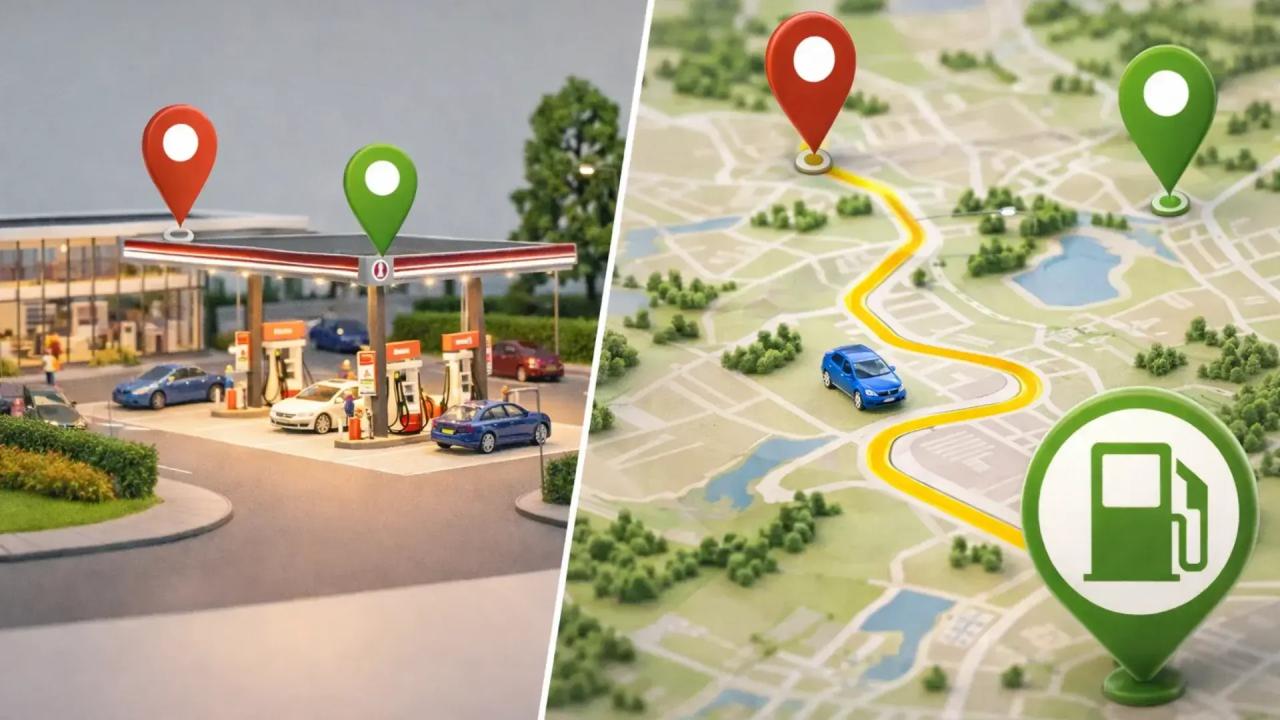
The nearest petrol station and the cheapest one within a reasonable distance are rarely the same place. Whether the difference is worth a detour comes down to two numbers: how much you save on the fill, and how much the detour itself costs in fuel.
Once you can estimate both, which takes about 30 seconds, the decision is usually clear. This article gives you the rule, worked examples, and a reference table you can bookmark.
Key takeaways
- The decision has two parts: the saving on the fill (price gap × litres bought) and the fuel cost of the detour (extra miles × your cost per mile). If the saving exceeds the detour cost, go. If not, stay.
- Fill size changes the answer more than most drivers expect. A 5p per litre saving is worth less than £1 on a 15-litre top-up and over £3 on a 60-litre fill. Small top-ups rarely justify meaningful detours.
- The motorway-services decision is the highest-value application of this rule because the premium is consistently large enough that leaving at the next junction for a cheaper forecourt usually pays back.
- Urban detours cost more fuel per mile than open-road detours. In stop-start traffic, the break-even distance shortens.
- Check prices before you leave, not while driving. The rule only works if you know the price at both stations before you set off.
The two-part calculation — stated simply
Saving on the fill = price gap (pence per litre) × litres you are buying.
Cost of the detour = approximate extra miles × your fuel cost per mile.
If the saving exceeds the detour cost, the detour is worth it financially. If not, it is not.
Most drivers can estimate their fuel cost per mile roughly enough for this calculation. At approximately 35 mpg, a typical UK petrol car average, and an illustrative fuel price of 140p per litre, each mile costs about 18p. At 50 mpg, closer to 13p. At 25 mpg, around 25p. You can see how much you could save by switching stations for a more precise figure tailored to your car.
All figures in this article are illustrative, using round numbers and an assumed fuel price of 140p per litre. Adjust for your own car and current prices.
Two quick worked examples:
Large fill: A 6p per litre saving on a 55-litre fill from near-empty saves £3.30. A 3-mile detour in a car doing 40 mpg uses roughly a third of a litre, about 48p at 140p per litre. Net saving: £2.82. Clearly worth it.
Small top-up: The same 6p per litre saving on a 15-litre top-up saves 90p. The same 3-mile detour still costs 48p. Net saving: 42p. Marginal, and that is before the time cost.
Why the same price gap can be worth it — or not
The saving from a price gap scales directly with how many litres you buy. The detour cost does not. A 3-mile round trip costs the same amount of fuel whether you then purchase 15 litres or 60.
This is why there is no single universal detour threshold. A driver buying 60 litres at a 6p per litre discount saves £3.60. A driver buying 15 litres at the same discount saves 90p. Same gap, same detour, very different outcomes.
A rough guide: if you are buying less than a quarter of a tank, only a very close cheaper station, under a mile of detour, is likely to pay back financially. If you are filling from near-empty on a larger tank, a significant price gap can justify 3 to 5 miles of extra driving.
The motorway services decision — where this rule pays most
Motorway service station fuel carries a persistent and substantial premium over supermarket forecourts and town stations. The gap is typically 10p per litre or more above the cheapest available alternative nearby, sometimes considerably more.
On a 50-litre fill at a 15p per litre premium, you are paying £7.50 more than you would at a supermarket forecourt a few miles off the motorway. The detour at most junctions is 2 to 4 miles, down the slip road, to the forecourt, and back. Even in a larger car at 25 mpg, that detour costs roughly 50p to £1 in fuel. The arithmetic is rarely close.
The only scenario where the services make financial sense is when the fuel warning light is already on and the next junction is further than your remaining range allows. If you have 30 to 40 miles of range, leaving at the next junction is almost always worth the two minutes.
A real example: southbound on the M1 between Toddington services and the junction 10 turn-off for Luton. The distance between the two is roughly 6 miles. A supermarket forecourt near junction 10 will typically be 10p per litre or cheaper. On a 50-litre fill, that is £5 or more saved for six minutes of driving and about 96p in fuel. Over a year of monthly motorway trips, that single habit change adds up.
Urban detours — why the calculation tightens in town
In stop-start urban traffic, fuel consumption per mile is significantly higher than on open roads. A car that does 40 mpg on a clear dual carriageway might manage 25 mpg or less in slow town traffic. That raises the fuel cost of the detour and shortens the break-even distance.
At 140p per litre, a 2-mile detour through congested town-centre traffic in a car doing 25 mpg costs roughly 50p, almost double the cost of the same distance on an open road. If the price gap is only 3p per litre on a 30-litre fill, the saving is 90p. Net: about 40p. Possible, but thin enough that the time cost probably tips the balance against it.
If the detour involves traffic lights, a busy roundabout system, or a known congestion point, lean towards the nearer station unless the price gap is substantial and the fill is large.
Why checking prices before you leave matters
The rule of thumb only works if you know the actual price at both stations before deciding. Comparing signs while driving is unreliable, prices change during the day, and the cheapest station may not be on your direct route.
Check what nearby forecourts are charging before you set off. The tool shows live forecourt prices sorted by proximity or price, so you can compare the nearest station against cheaper alternatives within a few miles. The data comes from the government’s Fuel Finder open data scheme, which requires major retailers to publish live price data.
Waze and Google Maps also show nearby stations with prices, sourced from user reports and Fuel Finder data. They are useful for a quick check on the road, though a dedicated fuel price comparison gives a more focused view.
The ideal time to check is before leaving home or the office. A driver who knows there is a cheaper station 2 miles off their planned route can factor it in from the start. A driver who notices the warning light 300 yards from an expensive services has fewer options, and less time to do the maths.
When the maths is not the main consideration
Time: A 5-minute detour saving £2.50 is a reasonable trade for most drivers. The same detour when running late for a meeting is not. The financial rule does not capture that trade-off; only you can decide whether it is worth it.
Tank level: If the warning light is on and the nearest cheaper station requires a 10-mile detour, the risk of running out is the primary concern, not the price per litre. The rule of thumb assumes enough range to make the decision freely.
Familiarity: A cheaper station on an unfamiliar route carries a small risk of getting lost or caught in unexpected congestion. For a driver who knows the area, this is negligible. For someone in an unfamiliar town, it is worth factoring in.
Late-night and remote areas: The nearest open station may be the only option. Price comparisons assume alternatives actually exist and are open at the time you need them.
A quick detour rule of thumb
All figures illustrative. Based on a petrol car at approximately 40 mpg and a fuel price of 140p per litre. Adjust for your car and current prices.
Fill volume | Price gap to justify 1-mile detour | 3-mile detour | 5-mile detour |
|---|---|---|---|
15 litres (small top-up) | 1.1p/litre | 3.2p/litre | 5.3p/litre |
30 litres (half tank) | 0.5p/litre | 1.6p/litre | 2.7p/litre |
55 litres (near-empty fill) | 0.3p/litre | 0.9p/litre | 1.4p/litre |
Interpretation: the minimum price gap per litre at which the detour fuel cost is fully recovered. Any gap above this figure is a net saving. At typical UK price differentials between stations (often 5 to 15p per litre), fills of 30 litres or more comfortably justify detours of 3 to 5 miles. Small top-ups need a larger price gap to break even, a 15-litre top-up needs at least a 3p per litre gap to justify a 3-mile detour.
Common mistakes
Mistakes to Avoid
- Deciding to detour based on a sign spotted while driving, by the time you arrive, the price may have changed or the station may be busy
- Calculating the saving but not the detour fuel cost, the detour is not free
- Applying the rule to a small top-up and deciding a large detour is worthwhile, fill volume changes the maths significantly
- Assuming motorway services are only slightly more expensive, the premium is typically large enough that leaving the motorway almost always pays back on a meaningful fill
- Checking prices at home but not accounting for intraday changes, prices do shift, though less frequently than day to day
- Sharing unverified fuel price tips on social media, check the source before acting on a second-hand price report
Keep reading
What Is a Good Petrol Price in the UK?
A good petrol price is one that is competitive for your area and station type, not just low against a national headline average. A price that looks expensive in a competitive super...
Is Eco Mode Worth Using? What It Actually Changes and When It Helps
Eco mode does save fuel. The changes it makes are real, and in the right conditions they produce a genuine if modest improvement in economy. The catch is that what Eco mode changes...
Does Engine Size Determine Fuel Costs? The Variables That Actually Matter More
Engine size does affect fuel consumption, and larger engines often use more fuel on average. But it is one of the weaker predictors of real-world running costs. Vehicle weight, dri...
PetrolSavings Editorial
Editorial Team
Explore fuel savings tools
Use calculators and local price searches to plan smarter journeys.
Prices and station info are refreshed continuously. Look for freshness timestamps when comparing fuel deals.