

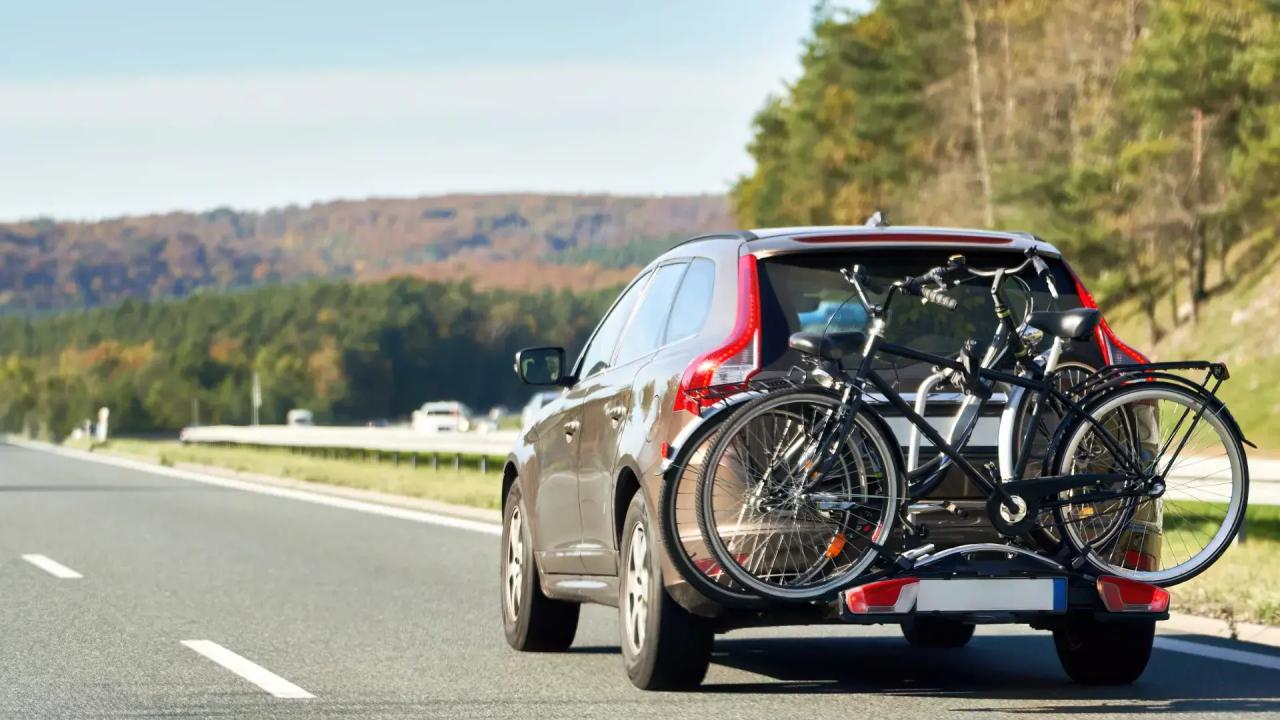
A roof box or bike carrier increases aerodynamic drag, and drag costs more fuel per mile as speed rises, not in simple proportion, but disproportionately. At 70 mph the engine works substantially harder to push the same accessory through the air than at 50 mph, and the gap is larger than most drivers expect.
This article explains the mechanism, ranks common accessories by their drag penalty, and lists five practical actions in order of impact.
Key takeaways
- The fuel cost of a roof box or bike carrier rises disproportionately with speed, because the power required to overcome aerodynamic drag increases with the cube of velocity. At motorway speeds, the penalty is substantially larger than at 50mph.
- Reducing motorway speed is the highest-return action when a roof box is fitted. The difference between 60mph and 70mph on a long trip represents a more meaningful fuel saving with a roof box than without one, because the drag penalty compounds at higher speeds.
- Empty crossbars on the roof create real aerodynamic drag at motorway speed and should be removed when not carrying a load. Flush roof rails integrated into the roofline have minimal impact.
- A rear-mounted bike carrier creates less drag than roof-mounted bikes in most configurations. It carries its own trade-offs: weight behind the rear axle, and in some setups a legal requirement for a lighting board.
- The exact percentage fuel penalty varies widely by vehicle, accessory, speed, and load. No single published figure applies reliably across all combinations. The practical order of actions is consistent regardless.
Why drag rises faster than speed
When a car moves through air, the force required to displace that air, aerodynamic drag, increases with the square of velocity. Double the speed and the drag force is approximately four times as large. But the engine power required to overcome that force compounds further, because power is force multiplied by velocity. The power needed to push a car through air at a given speed increases with the cube of velocity. Double the speed and the power requirement is approximately eight times greater.
Above roughly 50mph on a flat road, aerodynamic drag is the dominant energy cost for most passenger cars. A roof box increases the car’s frontal area and drag coefficient, two properties that directly scale the drag force. At 70mph, a roof box creates roughly twice the drag force it does at 50mph, but the engine needs to work roughly three times as hard to overcome it. The penalty compounds faster than the speed increase.
The accessory hierarchy — from least to most drag
Rankings are directional, actual drag penalties vary by vehicle, accessory dimensions, and speed. No sourced percentage figures are given because reliable like-for-like comparisons do not exist for the general case.
Accessory | Drag impact | Notes |
|---|---|---|
Flush roof rails (integrated into roofline) | Minimal | Designed to be aerodynamically neutral; no meaningful fuel penalty |
Empty crossbars on roof rail mounts | Moderate | Raised bars create turbulence and drag even unloaded, remove when not in use |
Aerodynamic roof box (teardrop profile) | Moderate to significant | Shaped to reduce drag coefficient; larger boxes still have meaningful frontal area |
Standard roof box (boxy profile) | Significant | Higher frontal area and drag coefficient than aerodynamic designs |
Roof-mounted bikes (2 or more) | High | Bikes are not aerodynamically shaped; multiple frames create substantial turbulence |
Rear-mounted bike carrier (1–3 bikes) | Moderate to high | Vehicle body provides partial shielding; less drag than roof-mounted but still significant |
Roof-mounted ski rack or kayak | Significant to high | Depends on frontal area and how far load protrudes above roofline |
The key insight from this ranking: the difference between removing crossbars entirely and leaving them on is a real fuel saving on any motorway run. Drivers who fit crossbars for occasional use and leave them on between trips are paying a continuous unnecessary drag penalty.
Why speed matters more than accessory choice
Because the power cost of drag scales with the cube of velocity, the fuel benefit from slowing down is amplified when a drag-adding accessory is fitted. The absolute fuel saving from driving at 60mph rather than 70mph is larger with a roof box than without one, the same speed reduction removes more fuel cost when the drag burden is higher.
A driver who would not normally consider 60mph on a motorway might find it worth considering specifically on the outward leg of a holiday trip with a laden roof box. The fuel economy case for keeping speed down is materially stronger when the car is carrying additional frontal area.
What it costs on a typical holiday trip
Illustrative example: actual impact varies by vehicle, accessory, and speed:
A 300-mile motorway run, roughly a London to Devon or Midlands to Lake District holiday leg, in a family car achieving 40mpg real-world uses approximately 34 litres of fuel. At 147.3p per litre, that costs approximately £50.08.
With a roof box fitted, real-world fuel economy at 70mph is lower, by how much depends on the vehicle and box. For illustration: if economy drops by 10% (towards the conservative end of published test ranges), the same trip uses approximately 38 litres, costing approximately £55.97, an extra £5.89. On a round trip, that is approximately £11.78 extra.
At 60mph instead of 70mph, the difference would be smaller, the speed reduction reduces both the base consumption and the additional drag penalty. Find the cheapest petrol on your route before you leave, at higher consumption, the price per litre gap matters more.
The 10% figure used here is indicative only, actual fuel penalty varies by vehicle, box size, and speed. Published figures range from single digits to above 30% and are not comparable across different tests. Run your trip computer for your specific car.
Five actions ranked by impact
1. Reduce motorway speed when a roof box is fitted
The highest-return action. At 60mph rather than 70mph, the drag penalty is meaningfully lower, and the time cost is modest (approximately 29 minutes on a 200-mile run). On a laden outward holiday leg, the combination of slower speed and lower drag penalty is the most fuel-efficient posture available.
2. Remove crossbars and the roof box between uses
Crossbars create drag even empty. A roof box removed after each trip saves the drag penalty on all subsequent runs. Fitting and removing takes 10–20 minutes and typically needs two people. If the box is fitted for four weekends per year and left on for the remaining 48 weeks, the fuel cost of the crossbars alone for those 48 weeks accumulates. For drivers who do most of their mileage locally, removal is clearly worthwhile. For frequent motorway drivers, the arithmetic is stronger still.
3. Choose an aerodynamic box over a boxy one if replacing
A teardrop or tapered profile reduces drag coefficient compared to a rectangular box of the same internal volume. The saving is real in direction but not drastic enough to change the other actions’ ranking
4. Consider a rear-mounted carrier for bikes
Lower drag than roof-mounting in most configurations, because the vehicle body provides partial shielding. Rear carriers add weight behind the rear axle, which affects handling, and some setups require a lighting board for number plate and rear light visibility, check the legal requirements for your specific vehicle.
5. Pack the box correctly
Heavier items low and centred; nothing protruding above the box’s profile. A long narrow box oriented lengthways has less frontal area than a short wide box oriented crossways. Correct loading keeps the drag profile as the manufacturer intended.
Three myths worth correcting
“A roof box increases fuel consumption by X%”
Published figures for roof box fuel penalties range from approximately 5% to over 30%, depending on the test vehicle, box type, speed, and load. These figures are not comparable across tests and do not apply reliably to any given driver’s combination. Any article that states a specific percentage without citing the exact test vehicle, accessory model, speed, and methodology is presenting a figure that may be substantially wrong for the reader’s situation. Treat the penalty as real and meaningful at motorway speeds, and check the trip computer on your specific car.
“Rear-mounted bike carriers have no meaningful fuel impact”
They have less impact than roof-mounted bikes in most configurations. They do not have no impact. A rear carrier with two bikes still creates significant drag at 70mph, the vehicle body provides partial shielding, but the bikes protrude behind the aerodynamic clean zone and create turbulence. The “rear is fine” belief understates the penalty.
“An empty roof box costs nothing in fuel”
An empty roof box still has the same frontal area as a loaded one. Drag is primarily a function of shape and size, not contents. The weight of the contents affects fuel consumption through rolling resistance, relevant on steep routes, but the aerodynamic penalty is present regardless of whether the box is empty or full. An empty box fitted between trips is still incurring the drag cost at every motorway speed.
Keep reading
What Is a Good Petrol Price in the UK?
A good petrol price is one that is competitive for your area and station type, not just low against a national headline average. A price that looks expensive in a competitive super...
Is Eco Mode Worth Using? What It Actually Changes and When It Helps
Eco mode does save fuel. The changes it makes are real, and in the right conditions they produce a genuine if modest improvement in economy. The catch is that what Eco mode changes...
Do Older Cars Use More Fuel? How to Tell What’s Age, What’s Neglect, and What’s Fixable
Older cars often do use more fuel. But the reason is rarely just age. The most useful distinction is between genuine mechanical wear that accumulates over time, maintenance neglect...

PetrolSavings Editorial
Editorial Team
Explore fuel savings tools
Use calculators and local price searches to plan smarter journeys.
We check for new prices every 5 minutes. Every price shows when it last changed, so check that before comparing deals.