

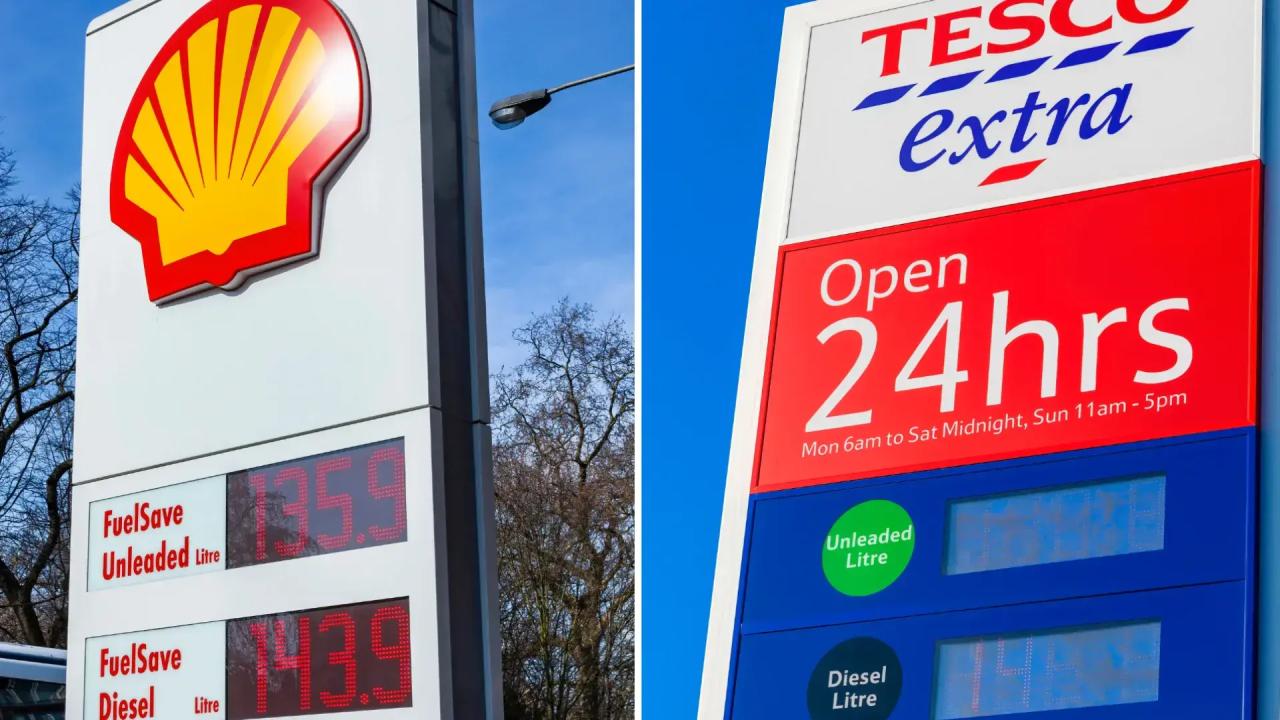
Supermarket forecourts are usually cheaper than branded stations. That part is straightforward.
What a simple price comparison misses is the detour cost, the value of loyalty schemes for regular shoppers, and the fuel quality question that leads some drivers to pay more by habit rather than by calculation.
This article works through all three, including the cases where branded stations make more sense than you might expect.
Key takeaways
- Supermarket forecourts are consistently priced below the national average, confirmed by both GOV.UK pricing data and the CMA’s 2023 road fuels market study. For drivers with a supermarket forecourt on their regular route, the saving is real and accumulates meaningfully over a year of weekly fills.
- The saving is not automatic for drivers who must detour. A 3-mile round trip to save 4p per litre on a typical fill may cost as much in additional fuel as it saves at the pump. The break-even point depends on the specific price gap and detour distance.
- For drivers who already shop at Tesco or Sainsbury’s, loyalty points on fuel purchases add further effective value beyond the pump price. The combined saving per litre can therefore be higher than the price gap alone.
- All standard-grade petrol and diesel sold in the UK meets EN228 and EN590 legal specifications. Supermarket and standard-grade branded fuel are legally equivalent. Premium branded products add proprietary additives, for which there is credible but engine-type-dependent evidence of benefit.
- The most reliable answer to “which is cheaper near me” is a live price comparison, not a category rule. The cheapest forecourt within a practical distance changes with market conditions and local competition.
The price gap — what the data shows
Supermarket forecourts, Tesco, Asda, Sainsbury’s and Morrisons, have consistently been among the cheapest in the UK market. The CMA’s 2023 road fuel market study confirmed that supermarkets priced below the market average over the study period, though the size of the advantage varied and narrowed during the 2021–2022 wholesale price surge.
For illustration: a 5p per litre gap on a 55-litre fill is £2.75 per fill, £143 per year at 52 fills.
You can compare fuel brands to see how prices differ between forecourt types in your area. The national average matters less than what your specific local options are charging today.
The loyalty card return — the value most calculations miss
Tesco Clubcard and Sainsbury’s Nectar both award points on fuel purchases. For drivers who already shop at either supermarket and redeem points regularly, these points add effective value on top of the pump price advantage.
If you fill up weekly at Tesco or Sainsbury’s and also do your regular shop there, the combined saving per litre, pump price gap plus points, is meaningfully higher than the pump price alone suggests. Check current earn and redemption rates directly with Tesco Clubcard or Nectar for the per-litre equivalent.
Asda does not operate a conventional loyalty points scheme in the same way as Tesco and Sainsbury’s. Its pricing strategy relies more on low pump prices than on points accumulation. Morrisons runs its More Card scheme, but the fuel earn rate is modest compared with Clubcard or Nectar.
The detour cost — the calculation most drivers skip
Driving to a supermarket forecourt that is not on your regular route incurs a fuel cost the price comparison does not capture. The calculation is straightforward: detour distance (miles each way, doubled) divided by your car’s real-world mpg, multiplied by the cost per litre, converted to litres.
Illustrative, adjust for your own car’s mpg and your actual detour distance:
A 2-mile detour (4 miles round trip) in a car achieving 40mpg uses approximately 0.45 litres of fuel. At 151.6p per litre, that costs approximately £0.68. If the supermarket saves 5p per litre on a 45-litre fill, the gross saving is £2.25. Net saving after detour fuel cost: approximately £1.57.
At a 5p saving per litre, the break-even detour distance, where the saving equals the detour cost, is approximately 6.5 miles each way. Much beyond a mile each way begins to erode the saving meaningfully.
For a driver who passes a supermarket forecourt on a regular commute, the detour cost is zero. The saving is the full pump price gap plus loyalty points. For a driver who must specifically drive to a supermarket, the net saving depends entirely on how far. Check the actual price gap at forecourts near you before committing to a detour.
Is supermarket fuel the same quality as branded?
Layer 1 — the legal specification: All petrol sold in the UK must meet the EN228 specification, and all diesel must meet EN590. These standards cover energy content, volatility, octane rating (petrol), cetane rating (diesel), sulphur content, and other properties. Every forecourt in the UK, supermarket, branded, or independent, sells fuel that meets these standards. The base product is legally equivalent.
Layer 2 — standard branded fuel: Standard-grade petrol and diesel at BP, Shell and Esso meets EN228/EN590 and nothing more. It is not meaningfully different from supermarket standard-grade fuel. Drivers who avoid supermarket fuel in favour of standard-grade branded fuel are paying more with no evidenced benefit at the standard grade level.
Layer 3 — premium branded products: Premium products, Shell V-Power, BP Ultimate, Esso Synergy Supreme+, contain proprietary additive packages formulated to go beyond the EN228/EN590 minimum. Independent evidence suggests these additives can reduce carbon deposit build-up in direct injection petrol engines, which are deposit-prone by design. The evidence for benefit in port-injection petrol engines and in diesel engines is less clear.
For most drivers in modern cars, the quality question is mostly irrelevant to the supermarket-versus-standard-branded comparison because they are legally equivalent. It becomes relevant only when comparing supermarket standard-grade fuel with premium branded fuel, where there is a genuine but modest and engine-type-dependent trade-off.
When branded stations make sense
The geography case: In areas where no supermarket forecourt is within a practical distance, the comparison is between different branded and independent forecourts. A dealer-owned branded forecourt prices independently of the fuel company. The cheapest forecourt in many rural areas is an independent, not a supermarket or a Shell.
The convenience case: Some branded forecourts are located at junctions or on routes where stopping takes four minutes rather than ten at a busy supermarket forecourt. Time has a cost. A driver for whom that difference adds up over a year of weekly fills is making a legitimate trade-off.
The premium fuel case: For drivers of direct injection petrol engines who want the potential maintenance benefit of premium fuel additives, a branded premium product is usually the only option because supermarkets do not generally sell equivalent additive-focused fuels. This is a minority use case, but a real one. Occasional use, perhaps every four to six fills rather than every fill, is the approach most evidence supports.
Who this advice actually applies to
Supermarket forecourts are concentrated in urban and suburban areas near the stores they serve. Many UK drivers, particularly in rural Cornwall, mid-Wales, the Scottish Highlands, and many smaller English market towns, have no practical access to a supermarket forecourt. For these drivers, the supermarket-vs-branded comparison is academic.
The useful question for these drivers is: which of the available forecourts in my area is cheapest right now? That is answered by a price comparison tool applied to a specific location, not by a category rule that does not apply to their geography.
How to answer this for your specific situation
Go to PetrolSavings and search for forecourts within your typical travel radius to see current prices near you.
Note the prices at the supermarket forecourts in your results and the nearest branded forecourts.
Calculate the actual pump price gap for your specific local options, not a national average.
If there is a supermarket forecourt on or very close to your regular route, the net saving is approximately the full pump price gap plus any loyalty card return. If you would need to detour, apply the detour calculation.
Bookmark the result. Prices change, and a forecourt that was cheapest last month may not be cheapest today.
Common myths about supermarket vs branded fuel
“Supermarket fuel damages engines over time”
There is no credible evidence for this claim when applied to EN228/EN590-compliant fuel. Supermarket fuel meets the same legal specification as standard-grade branded fuel. The AA and RAC have both addressed this claim and found no evidence of systematic harm from supermarket fuel in modern engines. The belief persists largely because of brand marketing and confirmation bias, with some drivers incorrectly attributing unrelated engine problems to the fuel they happened to be using.
“All branded fuel is the same regardless of grade”
Standard-grade branded fuel and premium-grade branded fuel are not the same product. Premium grades contain proprietary additive packages beyond the base specification. The extra cost is for the additives, not for any property required to make the car run safely. Standard-grade branded fuel is legally equivalent to standard-grade supermarket fuel; premium branded fuel is a distinct product with a distinct purpose.
“Filling up at a supermarket is always cheaper than anywhere else”
Supermarket forecourts are consistently among the cheapest, but not always the cheapest at any given location at any given time. An independent forecourt running a competitive pricing strategy can undercut local supermarkets. A supermarket in a low-competition area may not price as aggressively as one near several rivals. Live price comparison gives the correct answer; category rules do not.
Comparison at a glance
This table summarises general characteristics. Pump prices vary by location and time. Loyalty card values are based on current programme terms, so verify them before use.
Factor | Supermarket forecourt | Standard branded (BP, Shell, Esso etc.) | Premium branded (V-Power, Ultimate etc.) |
|---|---|---|---|
Typical pump price vs national average | Below average (typically) | At or slightly above average | Above average |
Fuel specification | EN228 / EN590 | EN228 / EN590 | EN228 / EN590 + proprietary additives |
Loyalty card return | Yes — Clubcard, Nectar (not Asda) | No standard scheme | No standard scheme |
Evidence of engine benefit over standard | N/A (is the baseline) | None vs supermarket | Credible for DI petrol engines; weaker for other types |
Queue risk at peak times | Higher — fewer pumps, high volume | Generally lower | Generally lower |
Best for | Drivers on regular shopping routes; loyalty card holders | Drivers prioritising convenience or location | DI petrol engine drivers wanting long-term deposit protection |
Best for: by driver type
Regular supermarket shopper with a forecourt on your route: Fill up at the supermarket. The pump price advantage plus loyalty points is the best available combination for your situation, with zero detour cost.
Driver with no supermarket forecourt nearby: The supermarket-vs-branded comparison is not your relevant question. Use a price comparison tool to identify the cheapest forecourt within a practical distance of your regular routes, the answer may be an independent, a branded, or a supermarket in a nearby town, depending on local competition.
High-mileage driver for whom fuel cost is a primary concern: The pump price is your biggest lever. Using PetrolSavings consistently to find the cheapest forecourt on each route can save more over a year than almost any other fuel-buying habit. At high mileage, even a consistent 3–4p per litre difference can add up to more than £100 per year on a 55-litre tank.
Driver of a modern turbocharged direct injection petrol engine: Standard supermarket fuel is fine for everyday use. If you want the potential long-term maintenance benefit of premium additives, occasional use of a premium branded product, not every fill, perhaps every four to six fills, is the approach most evidence supports. This adds modest cost and may reduce deposit build-up over the vehicle’s life. It does not make standard supermarket fuel unsafe; it is an optional maintenance consideration.
Keep reading
Petrol or Diesel for Low Mileage? It’s Not Just About Fuel Price
The usual advice is that diesel makes financial sense if you drive enough miles. What that advice often leaves out is the other half of the calculation: a diesel engine’s…
Premium Diesel: What You Actually Get for the Extra Pence per Litre
At most UK forecourts, premium diesel sits 5 to 12p per litre above the standard pump price. Over a 60-litre fill, that is £3 to £7 more every time.
How Petrol Is Made: What Actually Happens Between the Oil Well and the Forecourt Pump
Petrol does not come out of the ground ready to use. Crude oil is a mixture of hydrocarbons that must be separated, chemically upgraded, and precisely blended before it becomes the…

PetrolSavings Editorial
Editorial Team
Explore fuel savings tools
Use calculators and local price searches to plan smarter journeys.
We check for new prices every 5 minutes. Every price shows when it last changed, so check that before comparing deals.