

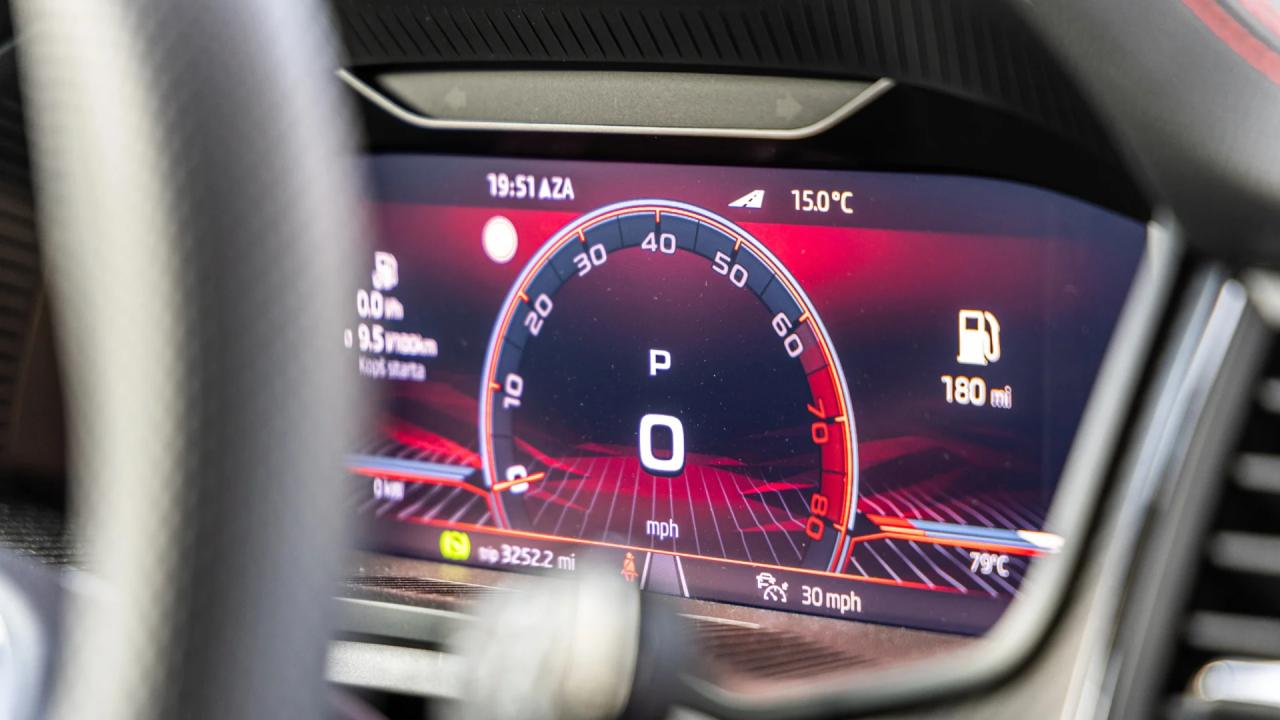
The MPG figure on your car’s brochure is a laboratory test result, not a target you should expect to hit on real roads. Real-world fuel economy in the UK depends on your car type, how far you drive, how fast you drive, and even what time of year it is.
For most vehicles, the actual figure will be noticeably lower than the official one. This article gives you realistic ranges by car type so you can compare against something that reflects UK driving, and tells you when a figure that seems low is genuinely worth investigating.
Key takeaways
- The WLTP figure on the brochure is a laboratory result. Most UK drivers achieve noticeably less in normal driving, and that is expected, not a fault.
- Journey type often moves real-world MPG more than drivers expect. Repeated cold-start 2-mile trips will usually produce worse figures than a steady motorway run.
- The meaningful comparison is against realistic ranges for your car type in similar conditions, not against the WLTP figure or another driver’s car.
- A practical rule of thumb is that a sustained shortfall of roughly 15–20% below the realistic range for your car type, measured over five or more fills in comparable conditions, is a sensible point to start investigating further.
- The most reliable way to measure your actual MPG is brim-to-brim over at least five fills. The dashboard display is a useful relative indicator but can read a little optimistically on some cars.
Why your car probably does not achieve its official figure
WLTP stands for Worldwide Harmonised Light Vehicle Test Procedure. It replaced the older NEDC test from September 2017 and became mandatory for all new UK car adverts and specifications for new ICE cars by September 2018. It is conducted in a laboratory under defined conditions: a specific temperature range, a set speed cycle, prescribed tyre pressures, no hills, no heating or air conditioning, and no passengers. The WLTP explanation from the Vehicle certification agency covers the technical detail if you want it.
In UK real-world driving (cold winters, stop-start traffic, school-run distances, motorway speeds above the test cycle) most petrol and diesel cars return less than their WLTP figure. This is normal, expected, and does not indicate a fault.
What you should compare against instead: realistic ranges for your car type and fuel type in UK conditions. These are lower than WLTP, wider than a single number, and vary by driving pattern. The tables below give those ranges. The WLTP figure is useful for comparing one car to another before buying, but on its own it is not a reliable benchmark for judging whether your current car is performing as it should. For model-specific official figures, use the GOV.UK / VCA car fuel and CO2 data tool.
Benchmark MPG ranges by car type: realistic UK figures
The ranges below are realistic real-world expectations for UK drivers in mixed driving conditions (roughly 50% urban, 50% mixed/motorway). All figures are UK MPG (imperial gallons, 4.546 litres per gallon). Hybrid and plug-in hybrid results vary more than petrol or diesel results by model and driving pattern. PHEV figures assume regular charging; without it, many PHEVs will return figures closer to a standard petrol in the same class.
Indicative benchmark note: the ranges in the table below are practical UK benchmarks, not a single official real-world dataset. They were compiled from representative UK road-test and owner-report figures reviewed in April 2026, then grouped by class so readers have a realistic comparison point rather than a brochure figure. Treat the HEV and PHEV rows as broad comparison bands, not precise expectations for every hybrid model.
Car type | Fuel type | Realistic mixed MPG range | Typical official WLTP band | Notes |
|---|---|---|---|---|
City car | Petrol | 45–58mpg | 52–64mpg | Cold-start penalty significant on very short trips |
Supermini | Petrol | 42–55mpg | 48–60mpg | Most common UK car category |
Family hatchback | Petrol | 38–50mpg | 44–58mpg | |
Family hatchback | Diesel | 50–62mpg | 58–72mpg | Better on longer runs; DPF risk on short trips |
Saloon / estate | Petrol | 34–46mpg | 40–55mpg | |
Saloon / estate | Diesel | 45–58mpg | 52–68mpg | |
Crossover / small SUV | Petrol | 34–46mpg | 40–54mpg | Heavier body vs hatchback equivalent |
Crossover / small SUV | Full hybrid (HEV) | 48–60mpg | 55–68mpg | Urban advantage; less at motorway speeds |
Large SUV | Petrol | 22–34mpg | 27–40mpg | |
Large SUV | Diesel | 30–42mpg | 35–50mpg | |
Full hybrid (HEV) | Petrol-hybrid | 50–62mpg | 56–70mpg | Best in urban/mixed; lower advantage on motorways |
Plug-in hybrid (PHEV) | Petrol-electric (charged) | 80–160+mpg | 120–400+mpg | Figures assume regular charging |
Mild hybrid (MHEV) | Petrol | 40–52mpg | 46–58mpg | Smaller efficiency gain than full hybrid |
Indicative benchmarks compiled from representative UK road-test and owner-report sources reviewed on 3 April 2026. Key sources reviewed included VCA WLTP guidance and What Car? Real MPG summaries, with additional context from UK efficiency guides and manufacturer summaries of third-party hybrid tests. Real-world results vary by model, trim, driving style, and conditions. Check the manufacturer's website for current WLTP figures for specific models.
The same car will achieve significantly different MPG depending on journey type. These ranges are illustrative for a typical mid-size petrol hatchback. Results vary by vehicle.
Journey type | Typical MPG range | Why |
|---|---|---|
Urban short trips (under 3 miles, cold start) | 24–34mpg | Cold-start penalty dominates; repeated warm-up cycles |
Urban mixed (5–10 miles, some cold starts) | 32–42mpg | Partial warm-up benefit; some stop-start efficiency loss |
Mixed A-road and town | 42–52mpg | Engine at operating temperature; moderate speeds |
Motorway cruise (65–70mph) | 45–55mpg | Engine warm, steady speed; aerodynamic drag dominant |
Motorway higher speed (75–80mph) | 38–48mpg | Aerodynamic drag increases sharply with speed |
What moves the MPG needle most: the variables ranked
Journey length and cold starts
Cold starts and warm-up losses are a major reason short trips return poor MPG. On a 2-mile trip, the warm-up phase is most of the drive. On a 20-mile run, it is the first mile or two. If you do predominantly short cold-start trips, your figures will usually sit at the lower end of the range for your car type, regardless of the car’s condition. For more on this, our guide to how cold starts and short trips affect your fuel figures covers it in detail.
Speed
Aerodynamic drag increases with the square of velocity. Driving at 75mph uses meaningfully more fuel per mile than 65mph. The difference between a 60mph and 70mph motorway cruise is real and consistent. For a motorway commuter, speed is the largest controllable variable.
Tyre pressure
Under-inflated tyres increase rolling resistance. A car running noticeably below its recommended pressure, for example around 8psi under, can show a measurable MPG reduction across most conditions. Free to check and correct.
Season and temperature
Winter MPG is genuinely lower than summer for the same car on the same routes. Winter-blend petrol has marginally lower energy density, cold oil and tyres increase friction, heaters and demisters place electrical load on the engine, and cold engines take longer to reach operating temperature. If you are comparing a February fuel log to a July one, expect a difference. That is normal, not a fault.
Load and roof equipment
A full car of passengers and luggage, or a roof box, increases consumption. Roof-mounted equipment adds aerodynamic drag at any motorway speed. Remove roof racks when not in use.
Air conditioning
At urban speeds, running the air conditioning places a meaningful load on the engine. At higher road speeds, the drag from open windows can outweigh the AC compressor load, so keeping the windows closed is usually the more efficient option.
Driving style
Smooth, anticipatory driving (maintaining momentum, reading the road ahead, avoiding unnecessary braking) is consistently more efficient than reactive driving. The effect is most noticeable in urban conditions.
Trim, wheels, and gearbox
Automatic and manual versions of the same model can return different real-world MPG. Larger wheels, wider tyres, sport trims, and all-wheel drive all reduce economy. “Same model” does not always mean “same expected MPG.”
How to measure your actual MPG: the reliable method
The dashboard MPG display is not the same as a measured figure. Many onboard displays read slightly optimistically because they calculate consumption from injection quantities and wheel speed, which can introduce small systematic errors. The dashboard number is useful for comparing one trip to another in the same car. It is less reliable as an absolute figure.
The brim-to-brim method. Fill to the first automatic click each time. Drive normally. Fill to the first automatic click again. Note the litres dispensed on the second fill and the miles driven between fills.
Calculation: MPG = miles driven ÷ (litres dispensed ÷ 4.546). The 4.546 converts litres to UK imperial gallons. Do not use 3.785; that is the US gallon and will produce a figure roughly 20% too low.
Worked example (illustrative, using round figures)
A driver fills up, travels 287 miles, then fills again with 42.3 litres.
UK MPG = 287 ÷ (42.3 ÷ 4.546) = 287 ÷ 9.30 = 30.9mpg.
This is the actual figure for those specific miles in those specific conditions, not an average across all driving.
Two fills gives a rough figure. Five or more gives a reliable baseline. You can measure your real MPG with a simple fill-by-fill log to build up a picture over time, and work out your cost per mile with current fuel prices to see what the MPG difference actually costs you.
When is low MPG worth investigating?
The question is not “am I below my WLTP figure?” Almost every UK driver will be. The question is: am I below the realistic range for my car type and driving pattern, and has that been sustained over several fills?
A practical rule of thumb is that if your measured figure over five or more consecutive fills is consistently around 15–20% or more below the lower end of the realistic range for your car type in similar conditions, it is reasonable to investigate further.
Before concluding something is wrong, rule out the normal variables. Has your driving pattern changed (more short trips than usual, urban miles versus motorway)? Has the season changed? Are your tyres at the correct pressure?
If the shortfall persists after accounting for normal variables, the common mechanical causes to check are: tyre pressure, spark plug condition (petrol cars), injector health, and whether a fault code is stored even if no warning light is showing. A garage diagnostic is the appropriate next step. A sudden drop, rather than a gradual decline, is a different signal with its own set of causes; if that describes your situation, our guide to sudden MPG drops covers it.
When to investigate further
- Measured MPG over five or more fills is roughly 15–20% or more below the realistic range for your car type in comparable conditions, after normal seasonal and journey-type effects are accounted for.
- The shortfall cannot be explained by more short trips, colder weather, or higher loads than usual.
- The drop appeared suddenly rather than gradually.
- A warning light has appeared alongside the MPG drop.
When to accept it as normal
- The figure is below WLTP but within the realistic range for the car type.
- Driving has included more short cold-start trips than usual.
- Winter driving is being compared to summer figures.
- A roof box or heavy load was carried during the measured period.
A note on hybrids: why their MPG picture is different
Full hybrids (HEVs) achieve their best real-world figures in urban and stop-start conditions, where the electric motor and regenerative braking are most active. At sustained motorway speeds, the petrol engine does most of the work and the efficiency advantage over a comparable petrol narrows. If you do primarily motorway driving in a full hybrid, your real-world figure may sit closer to an equivalent petrol than you expected.
Plug-in hybrids (PHEVs) with regular charging can produce very high MPG figures on short urban trips where the electric range covers most of the drive. Without regular charging, the same PHEV runs on its petrol engine while carrying battery weight, and may return worse figures than a comparable standard petrol. If you are disappointed with your PHEV’s economy, the first question is whether you are charging it regularly.
Mild hybrids (MHEVs) provide a smaller efficiency gain than full hybrids, particularly in urban use. Do not expect MHEV figures to match full hybrid figures in city driving.
Keep reading
Does Engine Size Determine Fuel Costs? The Variables That Actually Matter More
Engine size does affect fuel consumption, and larger engines often use more fuel on average. But it is one of the weaker predictors of real-world running costs. Vehicle weight…
UK Petrol Price History: The 2020–2026 Price Shocks, Record Highs, and What They Mean for Drivers Today
UK petrol prices went through more in six years than in the previous two decades. The collapse of 2020, the record-breaking surge of 2022, and the slow retreat that followed left p...
What Is a Good Petrol Price in the UK?
A good petrol price is one that is competitive for your area and station type, not just low against a national headline average. A price that looks expensive in a competitive super...

PetrolSavings Editorial
Editorial Team
Explore fuel savings tools
Use calculators and local price searches to plan smarter journeys.
We check for new prices every 5 minutes. Every price shows when it last changed, so check that before comparing deals.